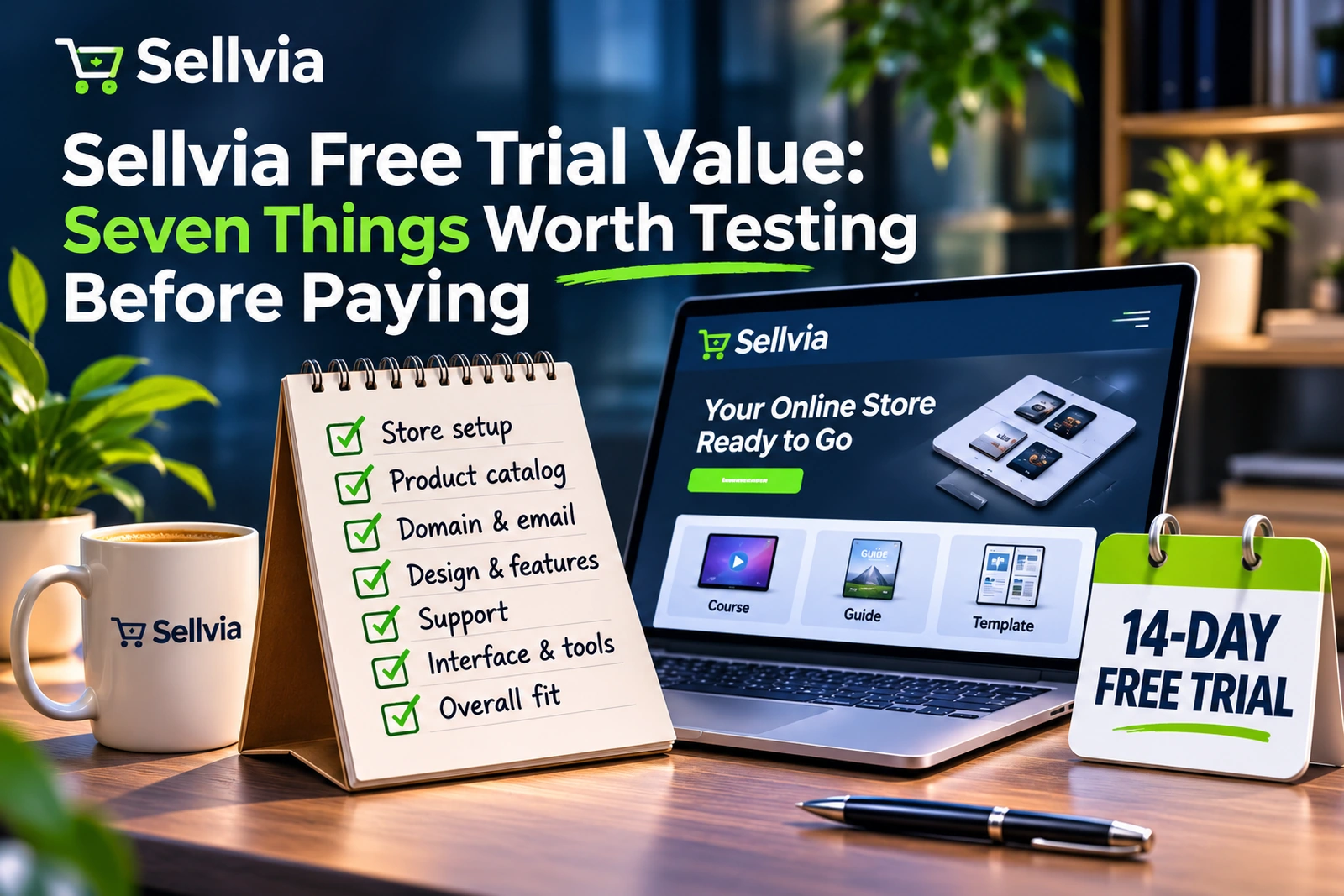
Editorial verdict. Sellvia’s 14-day free trial is most useful when treated as a structured inspection of a real business workflow, rather than as a race to make an immediate sale. The offer combines access to a ready-made digital-product store, an initial catalog, hosting and a way to explore the dashboard before the base subscription renews. That is a genuinely convenient starting point for somebody who would otherwise need to assemble several services. The most productive question is not “Can this make money in two weeks?” but “Can I understand, evaluate and operate the essential pieces confidently?” Seven focused checks can answer that question.
Sellvia’s Terms of Use specify a 14-day free trial for the base Sellvia PRO subscription, starting when store access details are provided. Its published entry-level monthly price is $39 after the trial. Separate purchased services are not necessarily covered by the trial and may be charged immediately. Some promotional pages display additional advertising credits, products or bundles; those offer-specific benefits should never be assumed to be available in every account.
How we assessed this offer. We reviewed the public subscription terms, current store-offer descriptions, the published help-center structure and independently hosted software feedback. We did not create a new paid account or collect a private dashboard recording for this article. Consequently, the seven tests below are a reproducible editorial audit, not a claim that our team has completed all seven inside an individual subscriber’s account. That distinction matters when judging a trial fairly.
What a two-week trial can actually establish
A trial cannot predict long-term demand, advertising profitability or future availability of a feature. It can, however, answer concrete operational questions: Does the storefront feel coherent? Are digital-product listings understandable? Can the account owner locate essential actions? Is the included infrastructure adequate for the proposed workflow? Are the boundaries of free and separately billed services easy to distinguish? Can a person ask for guidance and understand the answer?
That makes the trial valuable even when no sales occur. A first-time operator may learn that editing products is manageable, that the store design fits the intended audience, or that customer support documentation fills an important knowledge gap. Another operator might decide that a particular add-on is unnecessary. Either result is better than evaluating a subscription only by a promotional headline.
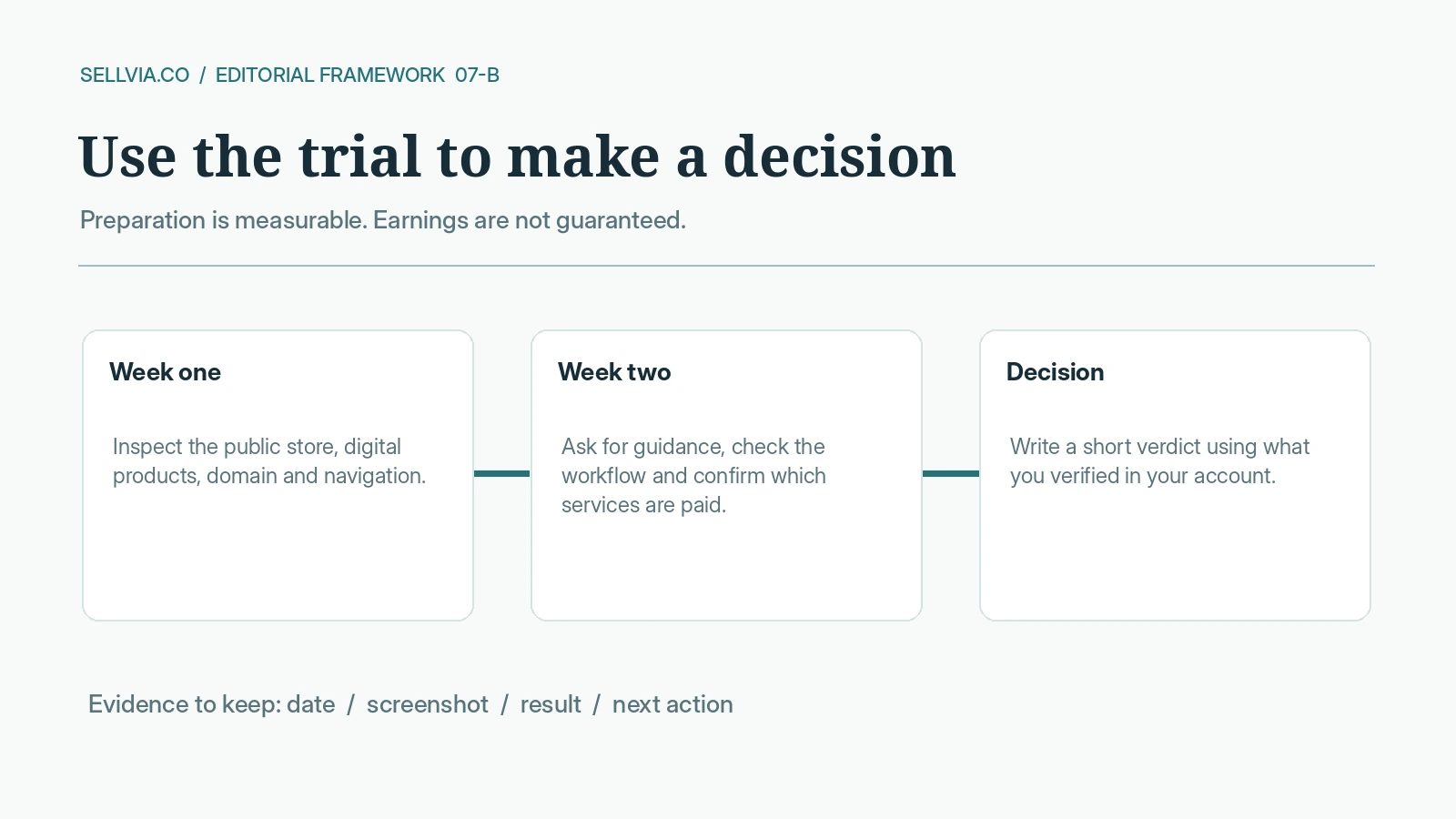
We suggest keeping a brief audit log. Record the date, device, page tested, question, result and one sentence about the consequence. Screenshots can support a decision, but a readable set of observations is more useful than an unlabelled folder of images. Because dashboard versions may differ by account and signup flow, test what your own account actually shows rather than borrowing screenshots from somebody else’s review.
Test 1: Inspect the public storefront as a visitor
Start with the storefront, not its control panel. Open the main page in a normal browser, then open it in a private window to see the visitor’s version. Browse navigation, the catalog, product pages, contact details and any checkout information that is visible without completing a purchase. The core test is whether a new visitor can understand what is being offered and find the next logical action without the owner’s explanation.
Check the design on a desktop and a narrow phone screen. Is the header legible? Do product cards preserve their spacing? Does the page show clear pricing and an intelligible description of the digital item? Is the business identity consistent? A store with coherent navigation, reasonable spacing and working links is already saving its owner a substantial setup task. Those qualities are more meaningful than a flashy demonstration page.
Do not assume that a visually complete storefront has been independently audited for accessibility, usability or conversion. Make your own notes: identify one strong page and one page that needs an improvement. The point of a ready-made store is that a beginner has a starting structure to improve, not that no judgment or editing will ever be required.
Test 2: Assess the starter products for actual buyer clarity
The Terms of Use describe 50 randomly selected Sellvia products uploaded into the standard free turnkey store by default. Promotions may show different quantities or catalog offers. Your account’s actual product list is the relevant evidence. Count the visible items, group them by topic and select a small sample of digital courses, guides or templates to inspect carefully.
Ask five buyer-oriented questions of each sampled product. Is the title specific? Does the description say what the buyer receives? Is the cover image clear at card size? Are the intended audience and usefulness obvious? Is the product positioned consistently with the rest of the store? A catalog that makes these answers easy offers substantial convenience because the owner is not starting with empty pages.
Do not grade products by how many appear in the catalog alone. Ten understandable listings can be a more coherent test of readiness than fifty unclear ones. And avoid inferring licensing rights, customer outcomes or file quality from a preview image: those require separate evidence. Our related starter-product quality review explains those distinctions in depth.
Test 3: Verify the domain, hosting and branded identity
Three parts of Sellvia’s turnkey setup are especially interesting because they usually involve separate decisions elsewhere: a store domain, hosting and one branded email address. Their inclusion is documented in the same section of Sellvia’s Terms. During the trial, confirm the domain actually shown in the browser, whether the storefront loads securely over HTTPS and whether the contact details reflect the identity you intend to present.
The supplied free domain has ownership and renewal conditions. Under the published terms, Sellvia owns that included domain; using your own registered domain is a different arrangement. That is not a reason to reject the free option, which is convenient for early testing. It is a reason to know which kind of address you are testing. Our domain comparison explores the longer-term branding decision.
For email, distinguish the existence of a branded address from verified mail deliverability. If access to a mailbox is included, send a test between accounts you control and record delivery, reply and spam-folder behavior. Never claim successful delivery before sending a test. For hosting, note basic page access and browser warnings; a meaningful uptime percentage requires continuous measurement over time, not one successful visit.
Test 4: Follow one complete dashboard learning path
The dashboard is where the store becomes operational. Rather than clicking at random, choose one modest objective: locate a product, understand where its price is displayed, find account settings, identify where an order would appear and determine where the owner would see balances or subscription details. Record how many steps are necessary and whether the labels make sense to a first-time user.
The positive value of an integrated account is reduced context switching. When a store, products and account controls belong to a connected environment, an owner may spend less time maintaining unrelated systems. That benefit should be judged by the journey that is actually available, not by an assumption that every promoted tool is enabled for every subscription tier.
Read a dashboard prompt before acting on it, particularly when it enables an additional paid service or activates recurring advertising. A good trial is about learning controls, not inadvertently creating costs. If a tool is unavailable in the assigned dashboard version, document that limitation rather than treating an external screenshot as evidence that the interface is broken.
Test 5: Rehearse the customer journey without making a false sale
Imagine a first-time customer who discovers a digital guide, reads the description, decides whether the price makes sense and needs reassurance about what happens after purchase. You can evaluate that journey without generating an artificial order, pretending to be a customer or spending money solely to demonstrate an outcome. Inspect only the stages that are legitimately accessible to you.
A clear product-to-checkout journey is a practical strength of a packaged ecommerce platform. But it does not demonstrate that commissions are immediately available, nor that an incoming order has already been processed. Sellvia’s model involves the merchant processing an order by paying the product cost before the commission is credited under the applicable balance rules. Separate the buyer-facing experience from the merchant’s operational and financial responsibilities.
Write down anything that could confuse a buyer: unclear delivery wording, insufficient product previews, missing contact information or a mismatch between promise and detail. Better instructions here may contribute more to a healthy store than adding another decorative element to the homepage.
Test 6: Evaluate support and guidance through a specific question
A trial provides an opportunity to discover how support fits the working experience. Start by searching the Sellvia Help Center for a realistic question. Note whether the article addresses the exact issue, gives the next action and distinguishes ordinary subscription access from extra purchases. If something remains unclear, use the available official contact channel in your account or the contact page.
A useful question is narrow: for example, “My account shows a branded address. Where can I check mailbox access and sending settings?” Save the exact response, if one is received, and judge clarity and follow-through. Do not judge a support service entirely by a fast first greeting. The valuable outcome is an explanation that enables the next correct step.
Sellvia also promotes access to a personal manager for guidance. That may be especially helpful when a newcomer needs priorities instead of a long list of features. However, consultation should not be confused with guaranteed sales or full operational management. Our separate Growth Manager assessment evaluates where personal guidance can add practical value.
Test 7: Understand the subscription and decide what should happen next
A trial decision is incomplete until the owner can explain what happens to the base subscription afterward and which optional services are already active. Review the exact plan assigned to your account, trial start and end dates, next billing date, currency and separately priced services. The published standard base plan renews at $39 per month after the fourteen-day trial; promotional conditions and tier entitlements should be checked against the checkout and dashboard associated with the account.
This is not another cancellation tutorial. Its purpose is to evaluate whether the service’s operating model and planned use are worth continuing. Consider your available time, the quality of the existing digital-product selection, confidence using the dashboard and the work still necessary to reach customers. The ability to make an informed choice is itself an advantage of a well-used trial.
If the main features meet your requirements and you know which services you are paying for, continuing can be a rational next step. If the product or workflow still does not fit, you have learned something useful without needing to invent a success story. For cancellation-specific steps, use the existing free-trial cancellation guide rather than mixing two search intents into this review.
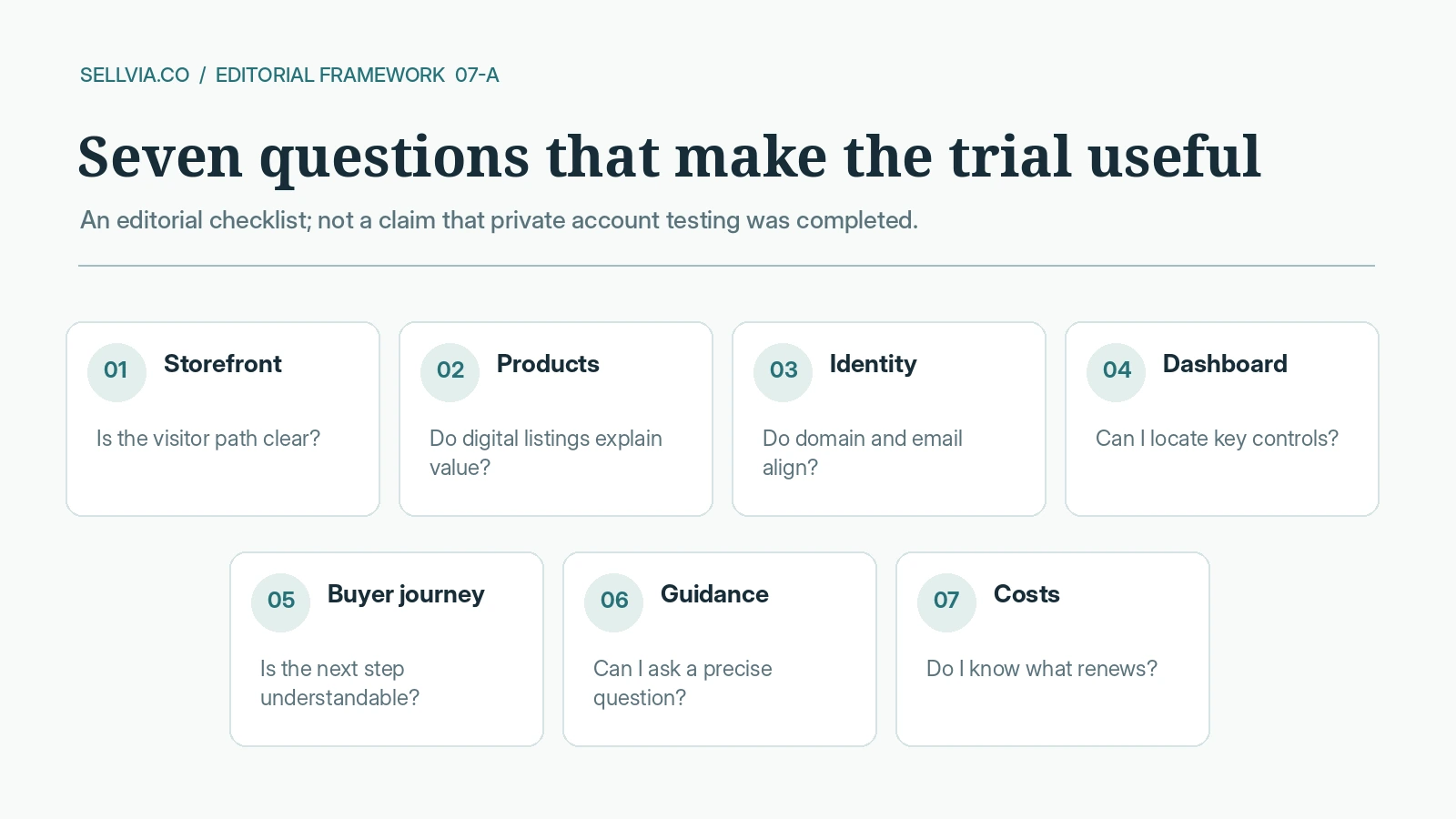
A realistic seven-check scorecard
A practical scorecard should capture evidence, not produce a fake platform rating. For each category give a simple status: Verified in my account, Needs clarification, or Not tested. Add a note describing the evidence. That approach makes a positive editorial judgment defensible while leaving room for unknowns.
| Area | Evidence to collect | Meaningful pass condition |
|---|---|---|
| Visitor storefront | Desktop and phone walkthrough | Pages are understandable and usable |
| Digital products | Sample titles, covers and descriptions | Buyer can understand what is offered |
| Store identity | Domain, HTTPS and mailbox details | Identity matches the store’s purpose |
| Dashboard | Short workflow note | Owner can locate essential controls |
| Customer journey | Buyer-facing page review | The next step is clearly explained |
| Help and guidance | Documentation or real response | Specific question receives a usable answer |
| Subscription fit | Trial and service summary | Costs and responsibilities are understood |
The scorecard deliberately avoids arbitrary percentage grades. Our publication has not verified the configuration of every Sellvia account and does not have a statistically representative sample of trial outcomes. The value of the framework lies in the questions it forces a reader to answer.
Where the trial is strongest for a beginner
Sellvia’s favorable starting point is that the user is evaluating a functioning collection of pieces rather than choosing every component independently. A ready-made storefront, products, hosting, catalog access and a support structure reduce early setup friction. For someone with no prior store-building background, this can make the first few days about comprehension and product selection rather than installing software.
This is a practical benefit, not an earnings forecast. Public marketing materials discuss advertising credits or additional bundles in certain signup flows. Those can make a particular promotion more attractive, but the credit amount and access conditions may vary. The right comparison is always the exact offer shown during registration and the base Terms of Use. A trial is strongest when those two documents can be reconciled without guessing.
Where two weeks are too short
A fortnight is suitable for judging navigation, initial content and assistance. It is much less reliable for determining organic search performance, recurring demand, customer acquisition economics or the behavior of a business over an entire billing cycle. Indexing may take time; advertising results depend on budget and audience; and early fluctuations tell you little without adequate observations.
Avoid inventing a “first sale on day three” benchmark. A new seller’s results will differ, and even a real first sale would not validate the rest of the operating model. Better early benchmarks are operational: you understand the order-processing requirement, can identify subscription charges, and know which work remains your responsibility.
Our editorial assessment of the published trial offer
We find the trial proposition compelling primarily as a low-friction learning environment. Bringing together a storefront, initial digital products, hosting and guidance makes an early ecommerce experiment easier to understand and potentially less intimidating. That is a specific and defendable positive: it concerns the breadth and structure of the documented starting package, not a promise of income or a claim that every feature has been independently tested.
The positive impression is strongest when users approach the trial with prepared questions. A newcomer who can navigate the store, evaluate the products and understand the money flow has acquired something more durable than a short-lived promotional impression. The essential qualification is that the offer’s exact included features and optional charges must be verified for the individual account.
Frequently asked questions
Does the trial give me a finished store or just a demo?
The standard documented offer includes a free turnkey store with hosted access, catalog access and a default set of products. The exact delivery and enabled features depend on the signup flow and account version. Inspect the actual public store before calling it finished for your purpose.
How long is Sellvia’s base free trial?
The current Terms describe fourteen days for the base subscription, beginning when store access details are provided. Check the start and renewal dates in your account and confirmation messages.
Are all additional services free for the same fourteen days?
No. The terms explicitly warn that optional services selected during store creation may be billed immediately. Separate campaign offers can also have their own conditions; read the specific checkout language.
Must I run paid ads to test the store?
No. Storefront usability, product-page clarity, dashboard navigation, support documentation and identity settings can be evaluated without creating an advertising campaign. Marketing effectiveness is a separate question.
Is a personal manager the same as technical support?
Not necessarily. A manager may help prioritize onboarding or marketing decisions, while a technical support request concerns specific functionality or account issues. Ask which channel is responsible for your question.
Can the trial tell me whether Sellvia will be profitable?
Not reliably. Fourteen days are useful for evaluating the platform and your willingness to operate it. Sales and profit depend on many factors beyond the initial setup, including promotion, product choices, costs and actual customer demand.
What should I keep when the trial ends?
Keep your seven-check scorecard, any correspondence, a record of the services enabled and a short list of improvements you would make. These notes help you evaluate the service with evidence rather than memory.
Sources and methodology. Sellvia Terms of Use; Sellvia storefront offer; Sellvia Help Center; Sellvia on Capterra. Public-source editorial review conducted November 5, 2026. No private subscriber account, test payment, support conversation or performance claim has been invented.

Andrew Porter is an ecommerce writer and online business researcher at Sellvia.co. He focuses on Sellvia’s platform features, pricing, digital product tools, built-in advertising, order management, and payment processes. Andrew creates clear, research-based content that helps beginners understand how the platform works, assess the required budget, explore its advantages and limitations, and make more informed decisions about launching an online business.
Leave a Reply