Editorial verdict. A personal Growth Manager can be one of Sellvia’s more useful advantages for a first-time digital-store owner, provided that the role is understood correctly. The practical value is not that somebody else takes over the business; it is that a newcomer can ask a human adviser to turn a confusing collection of options into a small number of sensible next steps. Sellvia prominently promotes guided onboarding, consultation and an assigned manager in several of its store offers. That is a positive feature because clarity, not another dashboard widget, is often what a beginner needs.
There is an important distinction between documented availability and a verified consultation outcome. For this review we examined Sellvia’s current public descriptions, its Terms of Use, the published help resources and independently hosted customer feedback. We did not book a private session or receive a transcript of an actual adviser call. The example consultations in this article are explicitly editorial scenarios, not reconstructed conversations with a Sellvia employee. We therefore assess the service’s defined purpose and how a user can evaluate a real meeting without manufacturing results.
What is a Sellvia Growth Manager?
Sellvia uses terms such as personal manager, Business Growth Manager and Growth Manager in public-facing material. The emphasis is broadly consistent: a person helps the customer understand setup, discuss business priorities and make sense of the platform. The company homepage refers to a dedicated manager and a free one-on-one consultation; another official getting-started article describes help with store setup, reviewing activity and answering questions by chat, email or scheduled call.
One highly specific commitment appears in the Terms for Established Stores: after payment begins, a Growth Manager is assigned and will contact the customer within one business day, or the next business day if a purchase happens on a weekend. Those same terms say the manager gives onboarding guidance and advisory support while ongoing management, promotion and advertising remain the customer’s responsibility. This timing should not be copied onto every free-trial account: it belongs to that particular purchase category.
Our interpretation is therefore practical and restrained. A Growth Manager is an advice and onboarding resource. It is not automatically a personal employee, an advertising agency, a guarantee of sales or a substitute for the merchant’s daily decisions. A reader gains more by understanding that boundary upfront than by relying on the phrase “done for you.”
Why human guidance can matter even with a ready-made store
A prepared digital store removes technical setup steps, but does not remove choices. Which courses or guides fit the intended audience? What deserves attention before investing more time? How should a user interpret a feature that appears in the dashboard but not in a tutorial? Which question belongs with customer support instead of marketing advice? These are ordinary beginner dilemmas rather than proof that the platform is complicated.
Human guidance is useful when it compresses the decision process. The owner arrives with a concrete problem and leaves with an ordered action list, a reason for the order and a realistic understanding of what remains outside the service. A knowledgeable adviser may explain why the next hour is better spent clarifying product descriptions than purchasing another optional tool. That sort of intervention has value whether or not it produces immediate revenue.
This is the strongest reason for our positive editorial stance. The platform does not present learning as entirely self-service; its offer includes a route for personal questions. Yet the benefit is conditional on the actual quality and specificity of the advice. We cannot infer a uniform level of performance from the mere existence of the role.
The five situations where we would seek a manager first
1. The store has arrived, but the owner cannot prioritize
The first login may reveal a ready-made store, several product categories and a number of tools. A useful consultation should identify one achievable objective for the week: for example, inspect five digital-product pages and decide which three fit the intended niche. That is more helpful than a long tour of every available option. The adviser should explain which decisions are necessary now and which can wait.
Ask for priorities in writing. A summary of three next actions reduces the chance that the owner remembers only a promotional detail. It also creates an objective way to assess follow-through: did the adviser answer the real question, or merely introduce more services?
2. Product selection feels arbitrary
A store can be stocked with digital products yet still lack a coherent proposition. The included catalog is a starting asset, not an editorial strategy. The manager can help discuss how product topic, buyer expectations and store messaging fit together. A buyer interested in planners may respond differently from one seeking specialist training material; the owner should be able to explain why the selected items belong together.
The manager should offer an understandable rationale, not claim to know the future best seller. Useful advice may involve making the first catalog smaller and clearer rather than adding as many products as possible. For a detailed quality-assessment framework, see our starter-products editorial check.
3. The account contains unfamiliar optional services
Sellvia’s Terms describe services and subscriptions whose availability can vary by dashboard version. That can make two customers’ screens look different. A manager may help identify which features are part of a particular offer and which require additional purchases. But the final billing answer should be confirmed against the account, checkout and terms, not inferred from conversational enthusiasm.
Ask the adviser to distinguish what is enabled, what is optional and what changes the next bill. A good explanation protects the customer’s ability to choose. It is also a healthy sign if the adviser says that an extra service is unnecessary for the immediate objective.
4. Promotion needs a realistic first hypothesis
A beginner often asks, “Which ad will make sales?” A more useful question is, “What is one small, measurable hypothesis about the audience and product?” That keeps the conversation in the territory of marketing judgment rather than guarantees. The manager can discuss the intended customer, what a product description promises and what evidence would make a promotion worth continuing.
Costs should always be separated from outcomes. Advertising credits shown in promotional offers are not cash and do not guarantee return. The user decides how to spend, whether to spend and how to interpret results. The value of the manager is in improving the decision, not in replacing that judgment or guaranteeing an outcome.
5. A confusing dashboard result needs context
Store activity, order states and commissions can be unfamiliar at first. When something seems inconsistent, a manager can help explain where to look or suggest the correct specialist channel. However, a financial or account-specific problem may require a formal support response, and no adviser should be expected to override documented service rules in an informal call.
The most valuable guidance clarifies what each displayed field means and what evidence is needed to understand it. It should not turn a pending balance into an earnings promise or confuse a recorded sale with withdrawable cash. A straightforward explanation here can prevent expensive misunderstandings.
A realistic first-consultation agenda
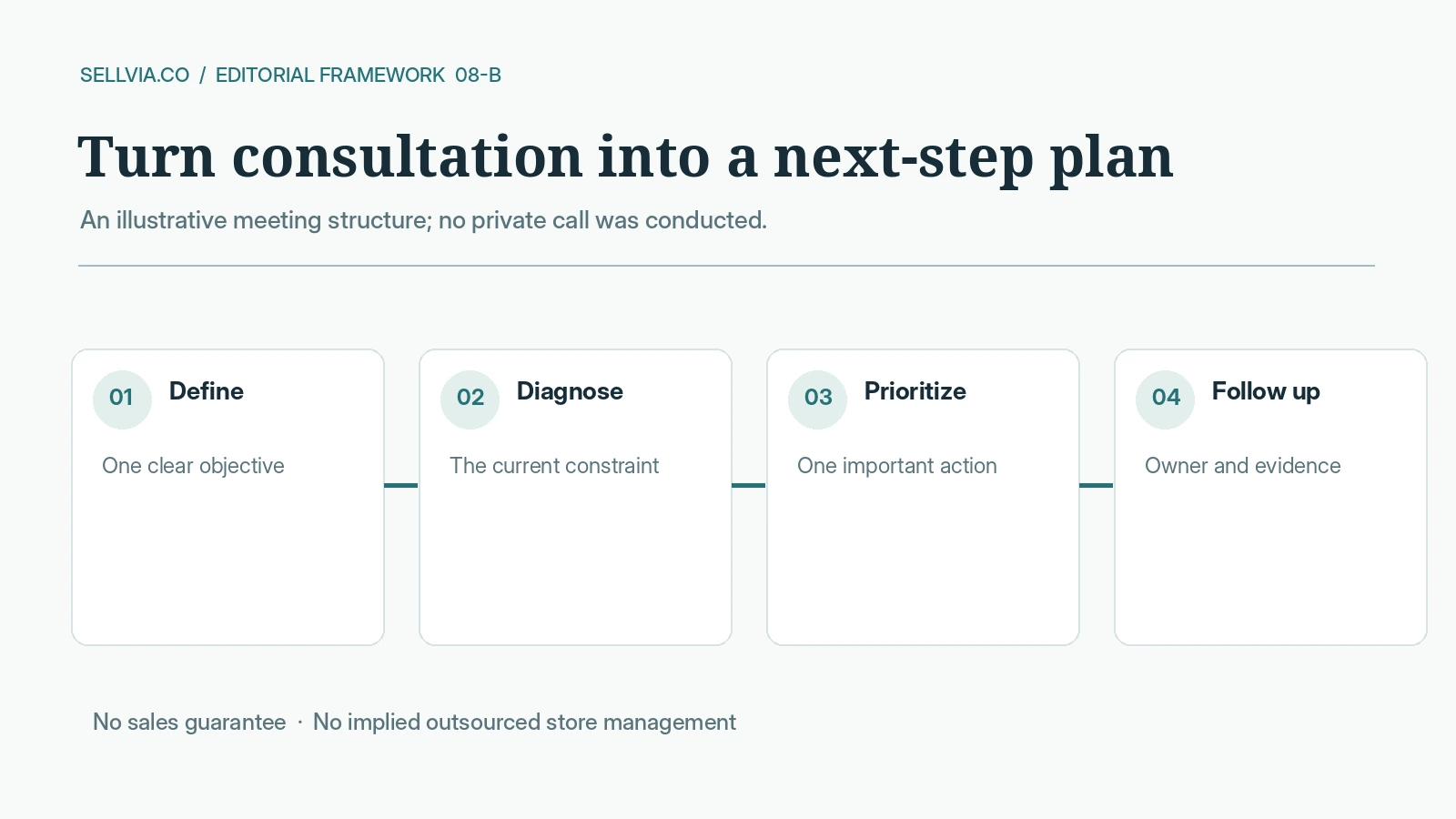
We recommend approaching the first meeting as a 25-minute decision workshop rather than an unstructured conversation. The owner should arrive with one sentence describing the store, three questions and an explicit time constraint. For example: “I have a digital guide store, I can spend five hours a week on it, and I want to know what to improve first.” The exact duration is an editorial planning suggestion, not a promised Sellvia appointment length.
A practical structure would be five minutes to describe the objective, ten minutes to inspect the highest-priority issue, five minutes to compare options and five minutes to agree on next steps. If the manager cannot view the store at the moment, the owner should prepare screenshots of non-sensitive parts of the dashboard. Do not share login passwords, full card numbers or unnecessary customer data.
The outcome ought to fit on one page: current position, recommended first step, why that step matters, who is responsible and when to reassess. This makes a consultation useful even if no further meeting is available. It also provides a fair basis for editorial evaluation: the advice either addresses the stated objective or it does not.
What we would ask a Growth Manager before buying anything extra
| Question | Why it matters | What a useful answer looks like |
|---|---|---|
| What is the first improvement to make? | Establishes priorities | One concrete task and a reason |
| Which three products fit this audience? | Tests product-positioning judgment | Specific selection criteria |
| Is the proposed feature in my plan? | Avoids offer confusion | Clear entitlement or price reference |
| How will we know whether the change helped? | Encourages measurement | An observable metric or comparison |
| Who handles a technical account issue? | Clarifies responsibility | The correct support channel |
| What should I do myself afterward? | Protects ownership of the business | A realistic action list |
We would consider an answer strong when it is specific enough to act on and transparent about assumptions. “Promote more” is not advice of the same quality as “Choose one guide category, rewrite the first paragraph to identify the buyer, then compare visits and purchases over a defined period.” The latter is still only a hypothesis, but it gives the owner a repeatable action.
What public sources actually confirm
The official Sellvia homepage advertises free one-on-one consultation and a dedicated manager. A separate official article about starting sales says a manager can walk users through setup and offer suggestions tailored to their situation. The Terms of Use contain explicit advisory-support language for Established Stores and separate contractual obligations that vary by offer. Taken together, these sources support the existence and intended advisory role of personal guidance, but they do not establish the quality of a particular meeting.
Independent third-party reviews add another layer. On Capterra, the service has a customer-service score of 4.6/5 in the published review summary reviewed for this article. This supports the view that many reviewers find the assistance satisfactory. It is not a randomized evaluation of Growth Managers, and some reviews describe different product eras or types of accounts. Ratings should inform a decision, not replace the evidence of a real consultation.
For readers who want to assess the manager personally, the best evidence is the quality of the actual response to a thoughtful question in their own account. We did not receive one during this editorial desk review, and do not attach invented dialogue or undocumented response times.
Manager, support representative and help center are different resources
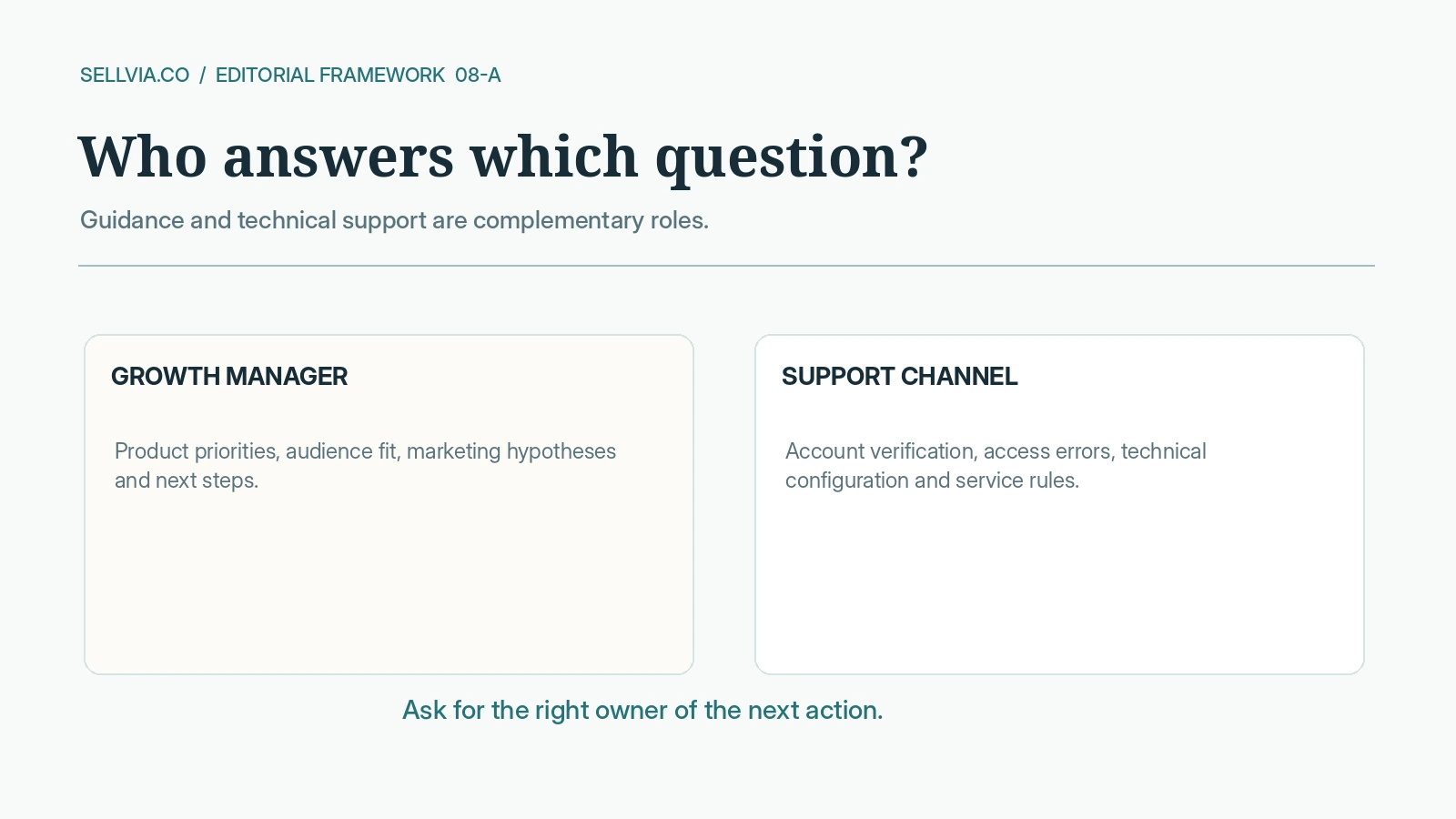
A human adviser can explain priorities, but may not be the right person to resolve a domain setting, billing discrepancy or access error. The Sellvia Help Center organizes published answers on getting started and dashboard use. The official contact page provides a support email and inquiry form. Those are clear routes when a question needs account verification or technical follow-through.
A useful rule is to assign the issue by its desired outcome. Need to choose a focus? Ask the Growth Manager. Need to confirm a paid service’s contractual terms? Consult the terms and account billing, then support if unclear. Need to solve a reproducible technical error? Contact support with the relevant steps and screenshot. Need to learn a basic feature? Start with the help center.
The presence of several routes is a strength only if the user understands the differences. A good onboarding conversation should help the newcomer identify those routes instead of treating every question as a sales discussion.
How to recognize useful guidance rather than generic encouragement
A productive manager first clarifies the customer’s goal and constraints. Relevant questions might concern available time, current product audience, ability to edit the store and whether any marketing has actually been attempted. Recommendations should reflect these answers. Advice that ignores the customer’s budget or actual interface may be motivational, but it is not well tailored.
Second, a useful explanation distinguishes a platform fact from a proposed tactic. “Your plan includes a basic storefront” can be verified in the terms. “Try presenting this guide to a narrower audience” is a hypothesis to test. “This will make you profitable next week” would be an unjustified promise. We place far more editorial weight on advice that respects these boundaries.
Third, the adviser should make it easier for the user to act independently. A good consultation teaches the reason behind the next action, so the owner can make similar decisions later. We see that as more valuable than cultivating permanent dependence on the manager for every minor change.
An illustrative consultation, not a reported conversation
Consider a hypothetical owner with a store containing digital productivity guides and templates. The owner has a few hours per week and is overwhelmed by multiple choices. A sensible adviser might begin by asking which buyer problem the store is supposed to solve. After reviewing several product pages, the adviser could suggest grouping related materials, sharpening the first sentence of each description and postponing optional services until the basic offer is clear.
The owner would then have three concrete actions: choose a primary category, revise a small set of product descriptions and check whether visitors understand what they receive. The result would be a clearer store proposition, even before any advertising was purchased. This is an editorial example of useful guidance, not a statement about a meeting Sellvia held or a result the company achieved.
This scenario explains why the managerial layer is attractive. The underlying recommendations are simple, but a newcomer may benefit from hearing the priorities in the right order. The quality of the consultation lies in how much uncertainty it removes.
The limits of a positive assessment
A manager cannot eliminate market risk or guarantee a commercial outcome. The customer retains responsibility for promotion and running the store. A personalized suggestion might be reasonable and still fail to generate demand. Similarly, the availability of a manager does not prove that every question receives immediate attention at all hours.
Public marketing pages may describe different contact methods, while terms or individual service conditions define what is actually available for a particular account. Before relying on a scheduled consultation, confirm how booking works, what channel is supported and whether the meeting is included in your offer. Avoid importing promises from an Established Store purchase into a base free-trial subscription.
These limits do not erase the value of guidance. They make it possible to appreciate that value for the right reasons: better priorities, more comprehensible decisions and clearer handoffs to support when specialized assistance is required.
Our editorial judgment
Our evaluation is favorable because Sellvia’s public model acknowledges an important beginner problem: having tools is not the same as knowing what to do next. A dedicated human adviser offers a path from setup to a practical plan and may make the broader ecosystem easier to navigate. The most defensible benefit is decision support, not outsourced management.
The highest-value moment is often the first serious strategic question: which product category deserves attention, what should be improved first and whether a proposed add-on is necessary. An effective response to those questions can save time and reduce avoidable choices. We would recommend using a manager as a source of targeted guidance, while keeping written notes and checking all costs independently.
Frequently asked questions
Does every Sellvia account get a Growth Manager?
Several Sellvia offers promote personal guidance, but specific access and arrangements may vary by signup flow and account type. Confirm the benefit in your assigned plan, dashboard or written account communication.
Will a manager run my store for me?
No such universal promise is established by the current Terms. For Established Stores, Sellvia explicitly places ongoing store management, promotion and advertising with the customer. Consultation is not the same as delegation.
Is a Growth Manager a technical support agent?
The roles may overlap in practical help, but a technical error, billing problem or security-related matter should be raised through the appropriate formal support channel. Ask the manager to direct you if the responsibility is unclear.
Can a manager guarantee my first sale?
No. A responsible adviser can discuss product choices and hypotheses, but sales depend on demand, pricing, promotion and many outside variables. An assurance of a specific commercial result would need evidence that generic guidance cannot provide.
What should I prepare before a call?
Bring one business objective, three precise questions, your available time and screenshots that do not expose sensitive information. Ask for a prioritized next-step summary.
How can I judge whether the advice was useful?
Check whether the adviser understood your question, separated facts from hypotheses, explained responsibility, and gave a concrete next action that fits your constraints. A pleasant conversation alone is not enough.
Is a positive third-party support rating proof of manager quality?
No. Ratings summarize users’ perceptions across different interactions and account types. Treat them as supporting context, while judging an adviser by the actual consultation and any written follow-up you receive.
Sources and verification. Sellvia Terms of Use; Sellvia homepage; Sellvia guide to the first sales; Sellvia contact options; Capterra reviews. Public material reviewed November 5, 2026. No private Growth Manager call or firsthand subscriber outcome is claimed.

Robert Gross is a contributing writer at Sellvia.co with a strong interest in ecommerce operations and the economics behind digital selling platforms. His articles examine how Sellvia’s tools work together in real business scenarios, including store setup, advertising, order processing, performance tracking, and cash-flow planning. Robert focuses on the operational details that are often overlooked, helping readers form realistic expectations, recognize potential challenges, and approach online business decisions with greater clarity.
Leave a Reply