More product choice is useful when it strengthens a coherent digital catalog.
A larger catalog can be attractive for a digital storefront, but quantity is not the same as range, and range is not the same as a persuasive offer. That distinction is at the center of my assessment of Sellvia’s Product Growth Subscription. The product adds access to a selection-and-import workflow for eligible catalog items in supported versions of the Dashboard. It does not take over a store owner’s decisions about what belongs in the shop. I consider that a useful premise: a good tool should enlarge the owner’s options while keeping the merchandising judgment visible.
The most important editorial question is therefore not whether a subscription can add many listings. It is whether access to additional courses, guides, templates, and other digital products helps create a more relevant, better organized storefront. For some owners the answer will be yes. For a store with an already confused identity, adding more material may simply multiply the problem. I would evaluate Product Growth by the quality of selection it enables, the clarity of its limits, and the amount of practical work it removes.
What the subscription actually gives access to
Sellvia’s current Terms describe Product Growth as a Dashboard subscription available only where the assigned account version supports it. The owner can browse eligible catalog products and manually select items for import. Products are chosen and added one by one. That operational description matters more than a generic promise to “grow your store,” because it identifies the real capability being purchased: additional choice and a route to bring selected listings into the existing storefront.
It also establishes what is not part of the promise. The subscription is not a hands-off merchandising agency, a guarantee of product demand, or automatic conversion optimization. The owner remains responsible for deciding which items fit the audience and how the store is presented. I see this as a reasonable division of labor. Sellvia can simplify the mechanical task of extending the catalog, while the owner keeps control of relevance and positioning. That makes the service potentially useful without pretending it substitutes for commercial judgment.
Why catalog expansion can matter for digital goods
A digital-product store may have a clear initial focus but still benefit from closely related offers. Someone browsing a productivity guide might also be interested in a planning template; a course about a practical skill may sit naturally alongside a workbook. A catalog tool with enough eligible choices can help an owner explore those combinations. The value is not only the number of imported products, but the ability to create a logical progression across a small collection.
For this reason, I would test the catalog on adjacency. Can the owner find items that complement what is already on the store? Do the descriptions explain different outcomes or merely repeat similar marketing promises? Are the product types clear enough to build meaningful categories? These questions turn a broad inventory subscription into a focused editorial evaluation. A useful addition should make the store easier to shop, not just longer to scroll.
The baseline comes before the upgrade
Before considering Product Growth, I would review the digital products already available in the initial store. Sellvia’s public materials have described different starting assortments and quantities across offers, so the actual account and its product pages are the appropriate baseline. The subscription should be judged against that baseline, not against a headline number seen elsewhere. If the existing assortment already covers the chosen audience convincingly, importing more items may be unnecessary at first.
The positive case appears when a clear gap remains. Perhaps the store has introductory guides but lacks useful templates, or offers several courses without an accessible quick-reference resource. A curated selection of additions can make the catalog feel more complete. Product Growth can help a focused owner fill such gaps faster than sourcing and preparing everything independently. But the editorial benefit depends on what is added, not the fact of having paid for access.
Start with the audience, not the import counter
Suppose the existing shop serves people who want practical resources for organizing their week. The owner could compare eligible planning templates, a related guide, and a course aimed at a clearly different level of experience. That comparison creates a more coherent customer journey than importing items solely because they appear near the top of the catalog. It also makes the product evaluation more meaningful: each addition has a job within the assortment.
I would write a simple sentence for each proposed item: “This belongs here because it helps the same audience accomplish the next task.” If that sentence is difficult to write, the product may be too remote from the store’s positioning. In this approach, Sellvia’s import tool is an accelerator for a considered decision. The strongest version of Product Growth is not a sprawling library but a selection tool that lets the owner build a sensible range deliberately.
A useful quality test for every new item
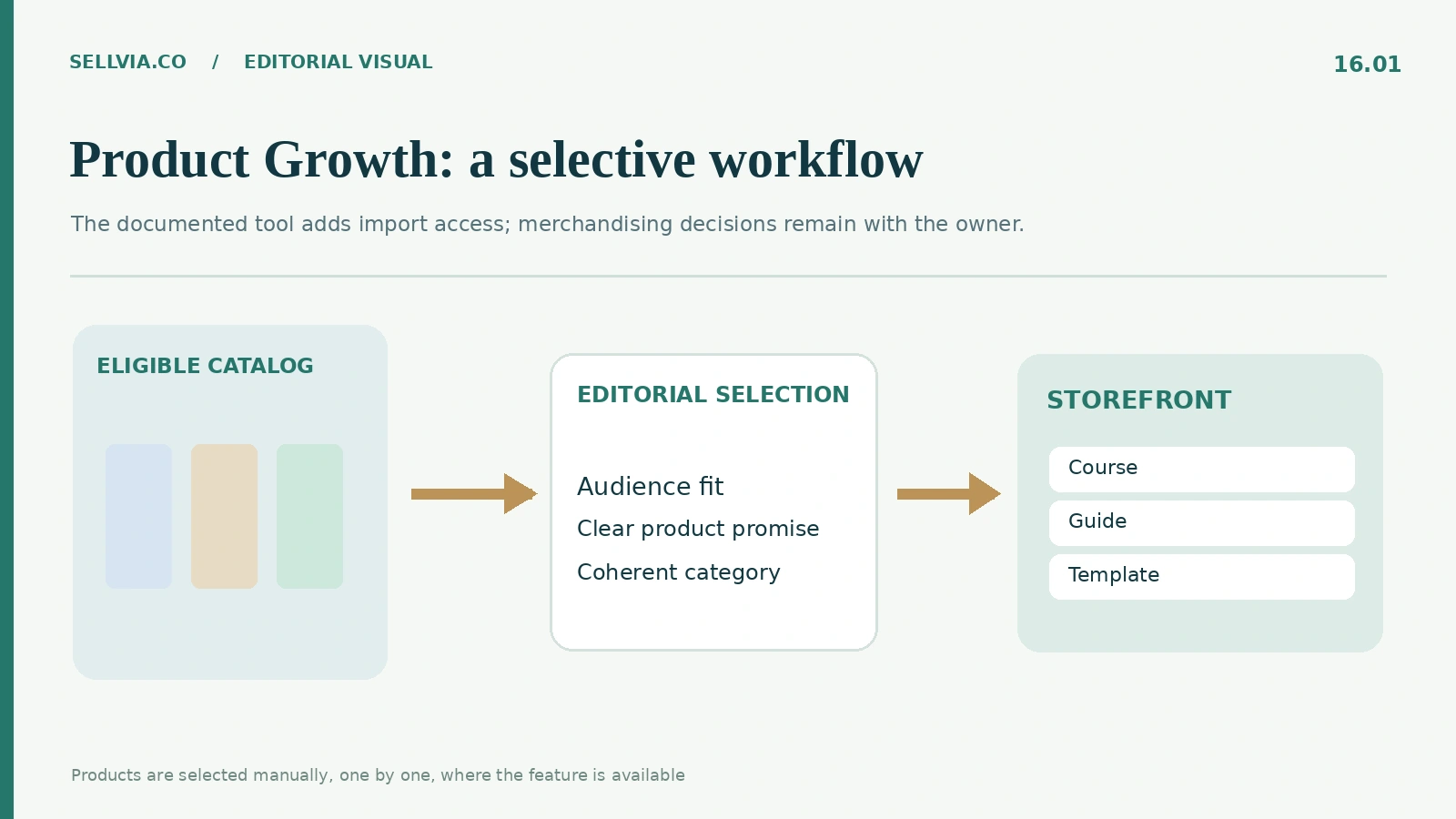
Before importing an eligible digital product, I would inspect its title, visual identity, description, format, audience, and clarity about what a buyer receives. A course should communicate what will be learned. A template should show what it helps organize or produce. A guide should describe its intended use without claiming extraordinary outcomes. The images should look coherent with the storefront and should not imply a physical shipment or an unrelated product category.
This is where editorial judgment becomes important. A ready-made listing can reduce preparation time, but a product card still needs to make sense next to its neighbors. If thumbnails, tone, and promises vary widely, the owner may need to adjust the storefront’s presentation. I would rather approve five relevant additions after a careful review than import fifty weakly connected products just because the subscription allows it.
Access does not mean automatic publication strategy
The current rules state that eligible products are manually selected and added one by one. That is a meaningful design choice. A user can pause, evaluate the next item, and avoid filling the storefront with unrelated categories. It also means Product Growth requires active attention. The owner cannot assume a larger store will appear in the background or that the platform will automatically decide the best product mix.
I see that as a fair tradeoff for a business owner who wants more influence over the assortment. Manual selection may be slower than an indiscriminate bulk process, but it can support better curation. The practical question is whether the interface makes selection efficient and whether the time spent reviewing items translates into a clearer offer. A thoughtful collection is more useful than an impressive import total that tells the visitor nothing about why the products belong together.
How the separate trial works
Sellvia currently describes a Product Growth trial that lasts seven days or until fifty products have been imported, whichever happens first, unless checkout states otherwise. That differs from the base store trial and should not be mixed with it. For an owner evaluating the feature, the limit is valuable information because it encourages a deliberate test rather than an open-ended assumption that all trials share one expiry date.
I would treat the trial as a chance to examine the quality and relevance of eligible selections, not as a challenge to exhaust fifty imports. Pick a small sample representing distinct digital formats, inspect how each listing fits the store, and decide whether the import workflow saves meaningful time. If the subscription is useful, the continuation decision should be based on that observed value. If there is no credible assortment gap, declining to renew may be the more rational choice.
The weekly plan changes the evaluation
Under the current default terms, after the separate Product Growth trial the service renews at $29 per week unless a different checkout price and schedule apply. The paid plan ordinarily permits up to 250 product imports per weekly billing period. Unused imports do not roll over. Those details are not just fine print; they shape the value proposition. Someone who plans a concentrated assortment-building period may use the quota differently from an owner who expects to add a handful of products each month.
My editorial calculation would begin with planned usage. How many relevant products have already been identified? How much time would manual sourcing and preparation otherwise require? Is the owner likely to use a meaningful portion of the access during the actual paid period? A weekly subscription can be convenient when there is real weekly work, but it deserves a deliberate calendar check. The useful comparison is cost against actionable catalog improvement, not an attractive maximum allowance.
The account version matters
Product Growth is not promised in every Sellvia Dashboard version. The Terms explicitly link eligibility to the assigned interface, which can vary by signup flow and account conditions. This is why a screenshot or tutorial from another account should not be treated as evidence that the subscription is available to everyone. Before building a plan around the feature, a user should confirm that the actual dashboard displays the relevant offer and what terms appear at checkout.
I consider this a crucial part of responsible editorial reviewing. A service can be genuinely useful for eligible accounts without being universal. Saying so clearly makes the positive evaluation more credible, not less. In a changing software ecosystem, a reliable publication tells readers what capability is documented, the circumstances in which it may appear, and the action needed to confirm their own access.
A merchandising problem the tool cannot solve alone
Imagine a store with a hundred unrelated digital products: language guides, workout templates, unrelated business courses, and seasonal planners all competing for attention on one homepage. Another fifty imports would not necessarily improve that store. The missing ingredient is focus. Before adding new items, the owner should decide which audience the store serves and reorganize the existing selection into clear pathways.
This is not a criticism of Product Growth. It is a recognition that import access is infrastructure for merchandising, not merchandising itself. The positive role of the tool becomes clear only after the audience and the next catalog gap are identified. I would treat assortment structure as a prerequisite rather than assuming the largest possible catalog is the most professional one.
A better use case: a focused extension
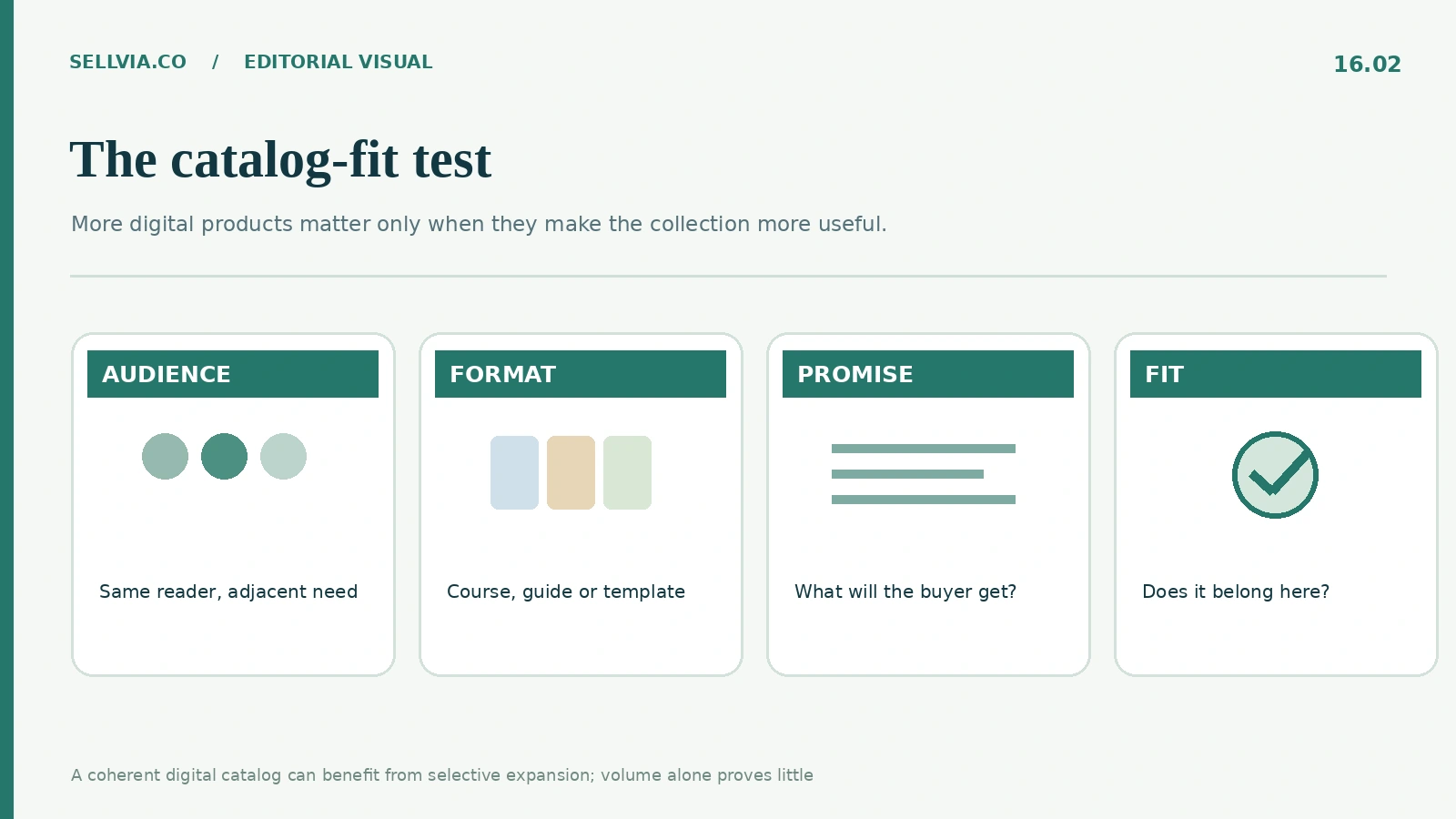
Now consider a different store with twelve clearly presented digital resources about everyday planning. Customers can understand the theme, and the product pages are consistent. The owner identifies a natural next category: editable templates that help readers apply the advice from existing guides. Product Growth may make that expansion easier by exposing eligible catalog products that can be selected and imported without starting from scratch.
The editorial quality check would compare the new template cards with the established ones. Do they explain the expected use? Can a visitor identify the difference between a downloadable guide and a reusable template? Is there enough thematic continuity for the new category to feel intentional? In this scenario, more access is genuinely useful because it solves a defined assortment problem. The platform supplies a faster path to additions; the owner supplies the strategy.
The content should remain distinguishable
Digital catalogs often contain products that appear superficially similar. Two productivity guides may promise overlapping benefits while differing in depth, format, or intended reader. The owner’s job is to make those differences visible. If every imported card has a generic description, expansion can dilute clarity instead of improving it. I would inspect whether the available product details provide enough information to distinguish the choice before it reaches the storefront.
The best result would be a catalog with an understandable hierarchy: introductory material, deeper learning, practical templates, and adjacent guides. That is easier for a customer to browse and easier for the owner to evaluate. Product Growth helps when it supports those meaningful distinctions. The editorial verdict should focus on how well the user can curate, not just how quickly an import action completes.
Editorial review of convenience versus effort
A ready-to-import digital product can eliminate several tasks: locating a suitable product source, creating a basic listing structure, and preparing starting visual and text material. That convenience is substantial for a small operator. But the owner should still review the description, select an appropriate category, check the fit with the store’s brand, and understand the commercial terms attached to the item. The tool reduces preparation; it does not remove accountability.
I would measure convenience through a simple before-and-after exercise. How many practical decisions remain after an item is selected? How much editing is needed to keep the catalog consistent? Can the owner return to the storefront and understand the new product’s place immediately? These questions avoid the exaggerated promise of instant business growth while giving fair credit for work that the platform genuinely simplifies.
How to decide whether to continue
The clearest renewal test is whether the owner has a concrete list of further relevant items to add. If the initial assortment gap has been filled, paying for another week simply because the feature exists may offer little benefit. If the owner is actively building a coherent second collection and the eligible catalog contains good matches, continued access may be worthwhile. The answer depends on planned work, not on a generalized claim that a growing store must constantly grow its product count.
I would also look at product-page quality after importing. A new category should be easier to navigate, not harder. If the customer journey becomes clearer and the editing burden remains manageable, the service has added practical value. That is the kind of positive conclusion that stands on observable changes rather than on imaginary revenue figures.
My editorial verdict
Sellvia Product Growth is most convincing as a selective expansion tool for an owner who already understands their storefront and wants more relevant digital items to choose from. The ability to browse eligible products and import them individually is a useful middle ground between a fixed starter catalog and building every new listing independently. The strongest benefit is controlled assortment flexibility. It can save preparation time and make adjacent digital categories easier to explore.
The limit is equally clear: access does not choose a niche, create demand, or guarantee sales. The owner still needs taste, discipline, and a reason for each new product. I see the subscription favorably when used for a defined catalog project, with the separate trial, weekly renewal, account eligibility, and import quota understood in advance. That is a more meaningful endorsement than claiming that product count alone equals growth.
Frequently asked questions
Does Product Growth import items automatically?
The current terms describe manual selection and one-by-one imports of eligible catalog items. The owner chooses the products rather than handing over the assortment decision entirely.
Is Product Growth included with every store?
No. It is a separate Dashboard subscription and is available only where the assigned account version supports the feature. Check the actual account and checkout.
How long is the Product Growth trial?
Unless checkout states otherwise, it lasts seven days or until fifty products have been imported, whichever comes first. That is separate from the basic store trial.
What happens after the trial?
The current default terms describe renewal at $29 per week, or at the rate and frequency shown at checkout. Review the actual offer before approving the subscription.
Do unused product imports carry forward?
The documented default paid allowance is up to 250 imports per weekly period, and unused imports do not roll over. A quota is most valuable when it matches the owner’s planned work.
Does a larger catalog guarantee better performance?
No. Relevant selection, clear product pages, coherent categories, and demand matter more than raw item count. The import tool makes more choices available; it does not replace those decisions.
Sources and further reading
Sellvia Terms of Use, Product Growth Subscription: https://sellvia.com/terms-of-use/
Sellvia current platform explanation: https://sellvia.com/what-is-sellvia/
Sellvia.co platform overview: https://sellvia.co/how-does-sellvia-work/
Sellvia.co pricing overview: https://sellvia.co/sellvia-pricing-explained/

Veronica Jameson is a digital commerce analyst and contributing author at Sellvia.co. Her work explores the practical side of launching and operating an online business, with particular attention to platform usability, advertising decisions, startup budgeting, and performance analysis. Veronica approaches each topic from a beginner’s perspective, breaking down unfamiliar processes and highlighting the details that can influence day-to-day results. Her goal is to give readers realistic context and useful guidance rather than simplified promises.
Leave a Reply