Which extras actually solve a problem, and what does the buyer receive?
The most interesting thing about Sellvia’s optional services is not the number of offers on a dashboard. It is the variety of jobs those offers are designed to accomplish. Some give the customer access to an interface or subscription tool. Some provide ready-made creative material. Others involve work carried out by a team. A beginner can easily treat all three as interchangeable upgrades when they actually produce very different kinds of value. That difference is where I would begin an independent editorial review.
My view is broadly favorable toward the modular approach. A prepared online store does not have to be accompanied by every imaginable extra service on day one. Being able to add a targeted capability later is more useful than being forced into a bloated package from the outset. But the choice becomes valuable only if the buyer understands the deliverable, the recurring obligation, and the work that remains in their own hands. This article is about making those distinctions, not reciting a price list.
The first question is what kind of service this is
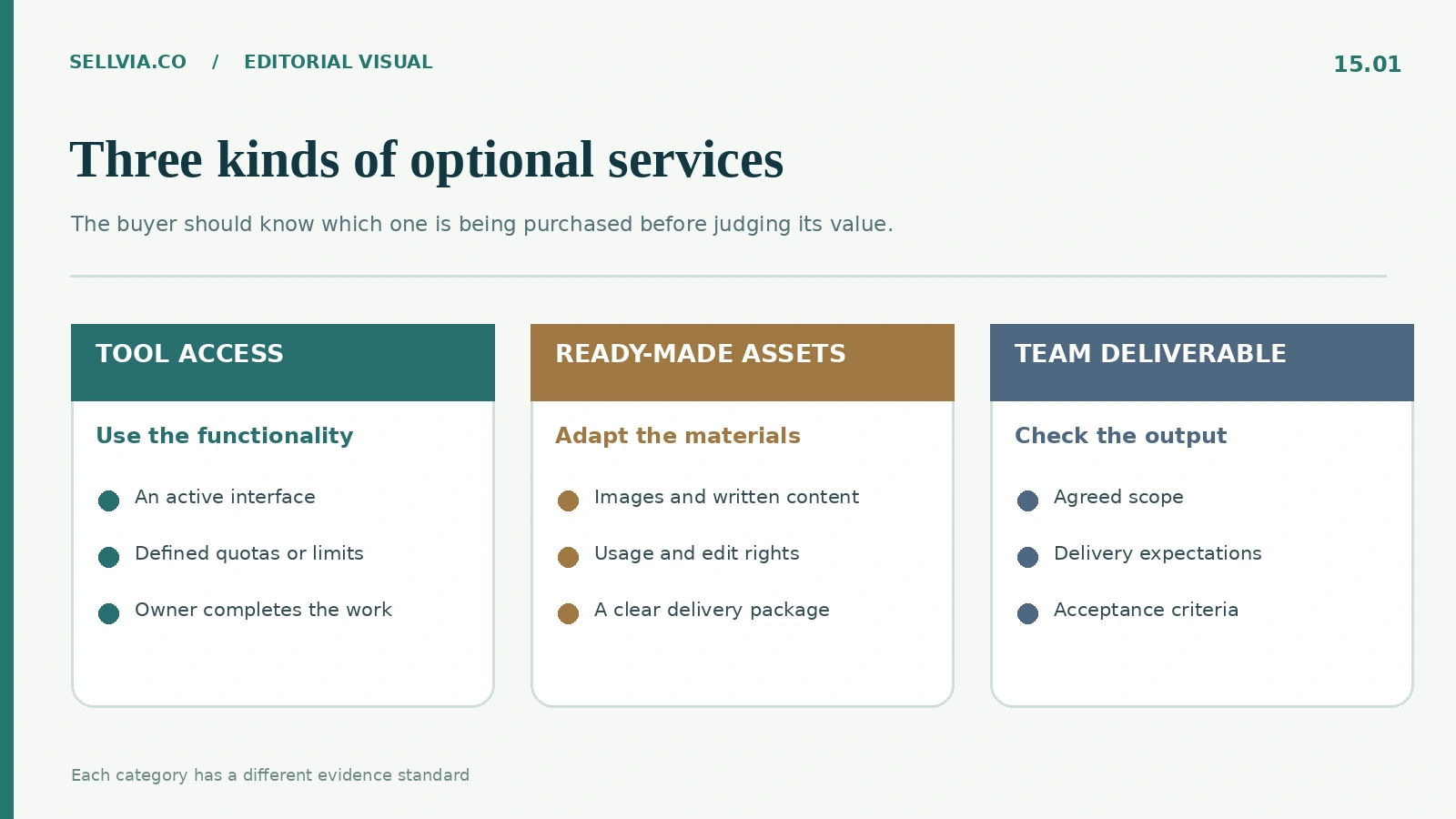
I divide Sellvia’s optional offerings into three practical categories. A tool gives you access to functionality, such as a subscription that allows eligible product imports. A content service gives you material to use, such as posts or creative assets. A managed deliverable means a team has a defined job to complete. Different categories call for different quality checks, and a buyer should know which category applies before evaluating any impressive marketing language.
For a tool, I would ask whether the interface is available in the specific account and what the usage limits are. For prepared content, I would inspect a representative sample for quality, relevance, and usage rights. For work performed by a team, I would look for a written scope, a delivery milestone, and a practical acceptance test. This is not excessive caution. It is simply how a service becomes a measurable business purchase instead of a vague feeling that more features must mean more progress.
A prepared store creates a sensible starting baseline
One of the strongest aspects of Sellvia’s model is that the basic subscription already brings together a storefront and related infrastructure. That makes optional services genuinely optional in concept. The owner has a baseline to evaluate before deciding what to improve. I consider that a healthy way to approach a platform: observe a real starting point, identify an actual limitation, and only then pay to remove it.
A beginner who has not inspected the existing digital catalog may not need more products immediately. Someone with a clear catalog and confusing presentation might value design guidance more. Another owner may already have the design they want but need better content for social media. These cases are not interchangeable, and a good services marketplace should make that obvious. The benefit of choice is strongest when every service is tied to a specific constraint the customer can name.
Self-service tools: flexibility with responsibility
A self-service tool can be attractive because it puts decisions close to the store owner. The Product Growth Subscription is a useful example: when available in the assigned Dashboard, it allows eligible catalog products to be selected manually for import. The subscription expands access, but selection remains an owner decision. I like that distinction because it preserves intentional curation instead of disguising catalog volume as a complete commercial strategy.
The same principle should guide other tools. Access to a dashboard control is not equivalent to a finished campaign, a redesigned store, or a guaranteed result. The owner may still need to configure the feature, make creative decisions, and monitor whether the output is useful. An honest editorial comparison should ask how many steps the tool removes, how much it still asks of the user, and whether those steps fit the owner’s current ability and time.
Ready-made materials: convenience depends on quality
A content package is different from a tool because the principal value lies in an output that already exists or is produced for delivery. For a digital-product store, useful assets might include a coherent set of social posts, creative concepts, or explanatory articles. The attraction is obvious: instead of starting with an empty document, the owner begins with material that can be reviewed and adapted. That can save creative time, particularly when a small team lacks a dedicated content specialist.
I would not judge the package by quantity alone. Ten carefully written assets with consistent audience targeting may be worth more than fifty generic variations. Inspect whether the message fits the digital catalog, whether screenshots are genuine or labeled as illustrations, whether the copy makes unsupported performance claims, and whether the materials can be edited. The genuinely positive finding would be an asset pack that reduces preparation while preserving the store’s distinct voice. A promise of lots of content is not enough by itself.
Team-delivered services need a clear finish line
A service performed by a team introduces a different question: what counts as delivery? Consider a design adjustment, creation of a marketing asset, or a setup task. The customer should know which elements will be changed, how many revisions are included if any, and how completion will be confirmed. Without this clarity, even high-quality work can lead to disappointment because the customer and provider imagined different results.
This is where I think Sellvia’s connected ecosystem has a potentially useful advantage. A provider that already understands the store environment can, in principle, avoid some of the onboarding burden of an unrelated contractor. The buyer should still verify that the proposed work concerns the actual storefront, products, or marketing channel they intend to use. Coordination is a benefit; it should not be confused with unlimited service scope.
The checkout screen matters more than a banner
The current Sellvia Terms explain that availability, pricing, and conditions can depend on the assigned Dashboard version and on specific checkout terms. This is a significant editorial point because a public sales page is not a universal entitlement for every account. It is also a good reason to review a proposed purchase in context. Before approving a new service, I would note the name, billing interval, total initial price, recurring charges, and the exact output or quota promised.
For subscription-style Dashboard services, the difference between weekly and monthly billing is particularly important. A price that looks manageable in a single purchase tile can become a larger recurring commitment when the calendar is considered. I am not against subscriptions; ongoing access often justifies ongoing payment. The useful standard is whether the renewal rhythm matches the actual rhythm of use. A service purchased once and forgotten is not delivering the benefit that made it attractive in the first place.
Different features call for different review criteria
A productive editorial test should fit the service. For an import-access subscription, count whether the eligible catalog genuinely contains useful new digital categories. For a theme or design service, evaluate legibility, branding, mobile hierarchy, and consistency. For a content package, examine original writing quality and adaptation time. For promotional work, measure what was delivered and where it appeared before claiming anything about traffic or sales.
This approach keeps an assessment positive without becoming credulous. It is entirely reasonable to say that an accessible catalog tool helps owners explore new niches, or that ready-made content reduces a blank-page problem. It is not reasonable to assume that a larger catalog or a published post automatically produces customers. A service is successful when it delivers the concrete capability it promised and when the buyer can use that capability intelligently.
Why I would resist purchasing several add-ons at once
For a new store, simultaneous upgrades make cause and effect hard to interpret. If the owner changes the theme, buys new content, expands the catalog, and starts promotion during the same week, it becomes difficult to identify which change actually improved the customer experience. There is also a risk of paying for outputs that are not yet ready to use. A disciplined approach is to choose one clear bottleneck and resolve it before adding another layer.
My preferred sequence is simple: begin with an observation, define the desired improvement, select the narrowest relevant service, confirm its terms, and review the result. Sellvia’s broad menu can work in favor of this approach because different categories of help are available without requiring every customer to follow an identical path. That is a stronger selling point than the vague idea that buying more services always accelerates success.
Case study: the store with a narrow digital catalog
Imagine a prepared storefront whose digital offerings are all concentrated in one subject. The owner has checked the product pages and found the descriptions clear, but wants to test whether the audience would respond to adjacent topics. A subscription that expands eligible catalog imports could address that bottleneck. The practical goal is not to fill the store with unrelated listings. It is to add a small, coherent range of guides, templates, or courses that complement the existing collection.
In this case, the editorial scorecard would focus on category relevance, description quality, ease of finding suitable products, and the total effort required to choose them. A well-chosen imported guide might improve the customer journey more than thirty scattered products. The Product Growth service can be a useful means of expanding choice; it should not be assessed as if it independently determines demand, merchandising, or commercial positioning.
Case study: good products, weak presentation
A different store may have an adequate assortment but inconsistent visual language. Some product descriptions are concise; others feel dense. The homepage has the right information but poor hierarchy on a phone. This is not principally a catalog problem, so an import subscription is unlikely to be the first purchase I would recommend. The owner needs to inspect design options, editorial presentation, and perhaps a specific service that addresses the layout.
This example illustrates why optionality is valuable. A platform that offers several service types allows the user to buy the kind of help they actually need. The service should still be assessed against a defined before-and-after comparison: Is navigation clearer? Are titles readable? Do product cards have consistent imagery? A positive review of the resulting design should be based on those visible improvements, not the name of the package.
Case study: an owner without time to create content
Consider a person comfortable with the store and its products but unable to produce consistent editorial or social material. Ready-made content can be particularly appealing here. The customer is buying time and a starting structure, not necessarily a bespoke strategy. The highest-value outcome would be content that fits the audience, explains specific digital benefits, and can be revised without losing its coherence.
I would inspect whether the materials avoid repetitive openings, fabricated testimonials, and generic claims of easy income. An asset should make the store more understandable, not merely louder. When good material gives a small business a reliable publishing starting point, the benefit is concrete. The owner can concentrate on selecting the strongest pieces, adjusting examples, and maintaining a consistent voice instead of producing every draft from a blank screen.
The importance of deliverable boundaries
There is a difference between access to software, a package of prepared assets, and a campaign managed on someone’s behalf. Those boundaries determine who is responsible for edits, publishing, spending, and results. Sellvia’s current service structure contains several of these categories, so a careful buyer should not infer that a subscription to one automatically provides another. A tool for generating or importing content is not identical to a team that publishes it.
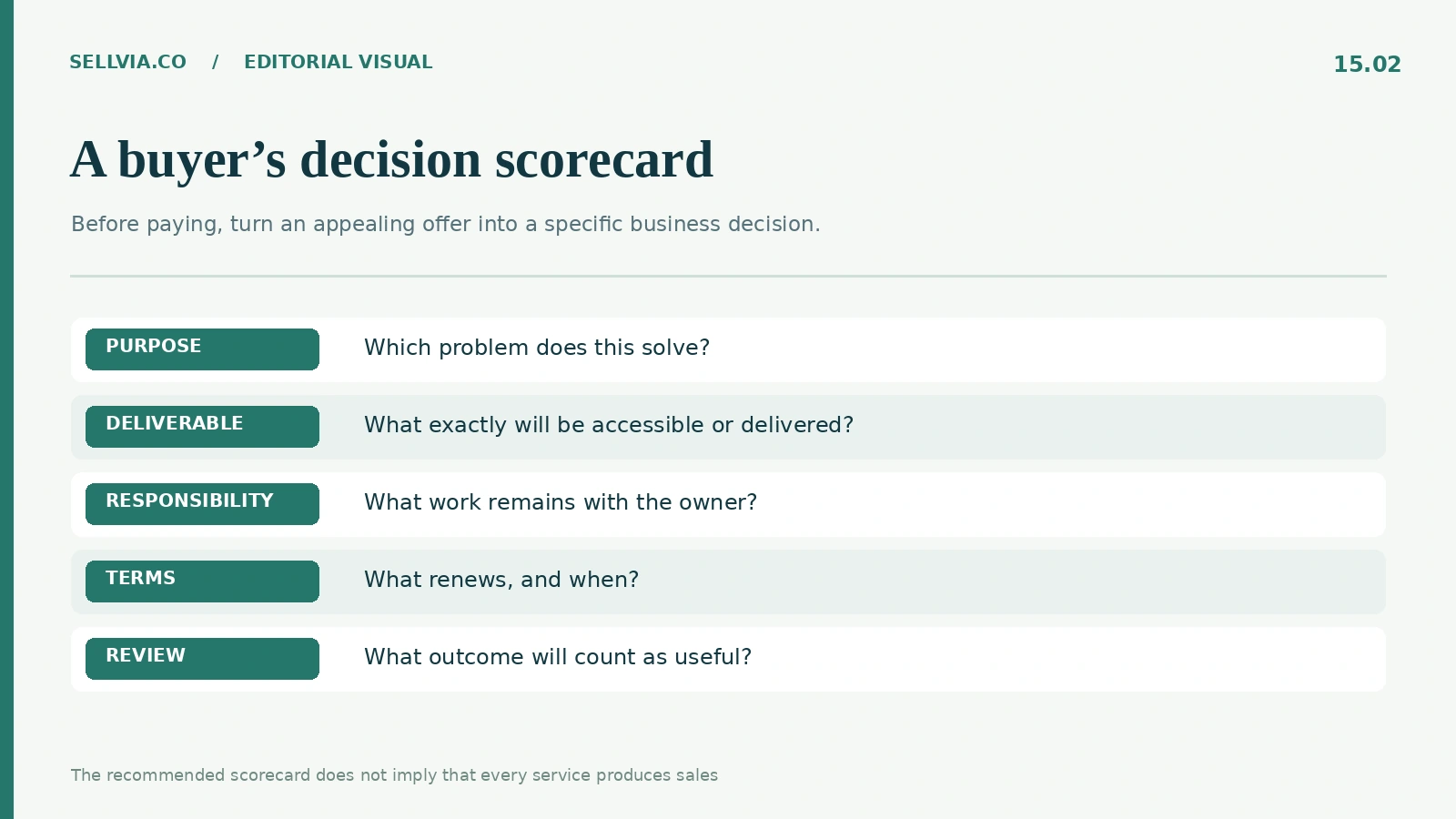
I would write the expected deliverable as one plain sentence before any purchase: “This gives me access to select more catalog products,” or “This provides a set of materials I can adapt,” or “This team will complete the stated setup task.” If the sentence cannot be written with confidence from the checkout information, the offer needs clarification. Good buying decisions begin with precise nouns and verbs, not enthusiasm alone.
Evaluating editorial quality after delivery
A service review should be willing to look beyond whether a download or dashboard access was technically provided. Did the material make sense in the context of the store? Does the design remain attractive on mobile? Can the owner explain how to use the new functionality without an hour of additional research? Are the promised assets actually available in the expected place? These are practical questions, and they make a strong positive assessment possible when the results are good.
I also value reversibility and clarity. The owner should be able to identify an active subscription, understand renewal terms, and know where to ask for help. That transparency increases the usefulness of optional services because it makes experimentation deliberate rather than intimidating. A business tool that is easy to inspect, learn, and manage tends to earn more sustained trust than one that relies on a dramatic initial promise.
My editorial verdict
Sellvia’s optional-service model is strongest as a menu of targeted capabilities layered on top of a prepared digital storefront. Access tools, content packages, and team-delivered work can all have real value, but they solve different problems. I see the flexibility as a meaningful strength for beginners who would rather start small and add capabilities as their needs become clearer. The right purchase is the one tied to a defined task, a visible deliverable, and terms the owner can explain.
The more thoughtful question is not “Which add-on should I buy?” but “What specific limitation do I now have evidence of?” That framing makes the platform’s breadth an advantage without implying that every optional service will be necessary or equally useful. Used selectively, a connected service ecosystem can save time and reduce the friction of working with unrelated vendors.
Frequently asked questions
Are Sellvia optional services included in the base subscription?
Some core features are included, but many premium tools, packages, and services are separate purchases. Check the active plan and the exact checkout description for the account.
Do all accounts see the same offers?
No. Current terms allow different Dashboard versions, account eligibility, service availability, and checkout conditions. A public example may not correspond to every customer’s interface.
Is a digital-content package the same as having posts published for me?
Not necessarily. Access to assets, creation of assets, and active publication are distinct deliverables. Confirm which one is being purchased and what the customer must do afterward.
What is the best first add-on for a beginner?
There is no universal choice. First inspect the store and identify a specific limitation in catalog fit, design, content, or workflow; then select the narrowest service that addresses it.
Does more product access automatically mean more sales?
No. More eligible products expand choice, but the owner must still assess relevance, positioning, product detail quality, and demand. Access is a capability, not a sales guarantee.
How should I evaluate a service after delivery?
Compare its stated scope with the actual output or access provided. Then judge usability, relevance, quality, and whether it genuinely reduced the work you intended to solve.
Sources and further reading
Sellvia Terms of Use: https://sellvia.com/terms-of-use/
Sellvia overview of the platform: https://sellvia.com/what-is-sellvia/
Sellvia.co pricing guide: https://sellvia.co/sellvia-pricing-explained/
Sellvia.co platform workflow: https://sellvia.co/how-does-sellvia-work/

Robert Gross is a contributing writer at Sellvia.co with a strong interest in ecommerce operations and the economics behind digital selling platforms. His articles examine how Sellvia’s tools work together in real business scenarios, including store setup, advertising, order processing, performance tracking, and cash-flow planning. Robert focuses on the operational details that are often overlooked, helping readers form realistic expectations, recognize potential challenges, and approach online business decisions with greater clarity.

Leave a Reply