
Quick answer. Hosting is among the components explicitly included with Sellvia’s free turnkey store in its published Terms of Use. That is useful because the owner can receive a storefront without first selecting a separate host, installing WordPress or connecting the site’s software to an independently purchased server. The benefit is a simpler launch process, not a measured guarantee of uptime or speed. Our editorial evaluation is favorable about the reduced setup burden; it also explains what a store owner should verify before relying on any hosting arrangement for a customer-facing business.
What we actually checked
This is an examination of Sellvia’s documented turnkey hosting offer and a practical framework for evaluating the hosted store after delivery. We checked the service language in the Terms of Use, which describes the turnkey store as a WordPress site with the Sellvia platform plugin and a hosting service. We did not administer a freshly provisioned customer store, measure its server response times, or review private incident logs. Those unobserved results are not presented here as facts.
A meaningful independent hosting review must answer two distinct questions. Does the service remove technical work from the person starting the store? The documented package supports that conclusion. How does a particular hosted site perform during normal use or an unexpected failure? That demands a test URL, repeatable measurements and a defined observation period. Many articles blur those questions and call an included host ‘fast’ without saying where, when or how it was tested. We prefer a narrower, more useful assessment.
Why included hosting matters more than it sounds
A website builder and a website host are not the same service. A store owner who starts with an empty WordPress installation typically needs a hosting account, a configured domain, a database, HTTPS, theme and plugin installation, backups and some understanding of updates. Some managed packages handle many of these steps, but the buyer still has to select and coordinate them. A ready-made store with hosting already integrated compresses that early procurement stage into one provider relationship.
For a beginner, the hidden cost of self-setup is usually uncertainty rather than the price of server space alone. Which configuration fits the platform? Who helps if the site becomes inaccessible? Does a domain change require changing DNS records manually? Is the ecommerce plugin supported by the host? Sellvia’s integrated promise reduces the number of independent decisions at the point of delivery. The owner can begin by checking an existing storefront instead of diagnosing a new installation. That is a substantial convenience even if one never claims it is the cheapest possible infrastructure.
The published hosting commitment
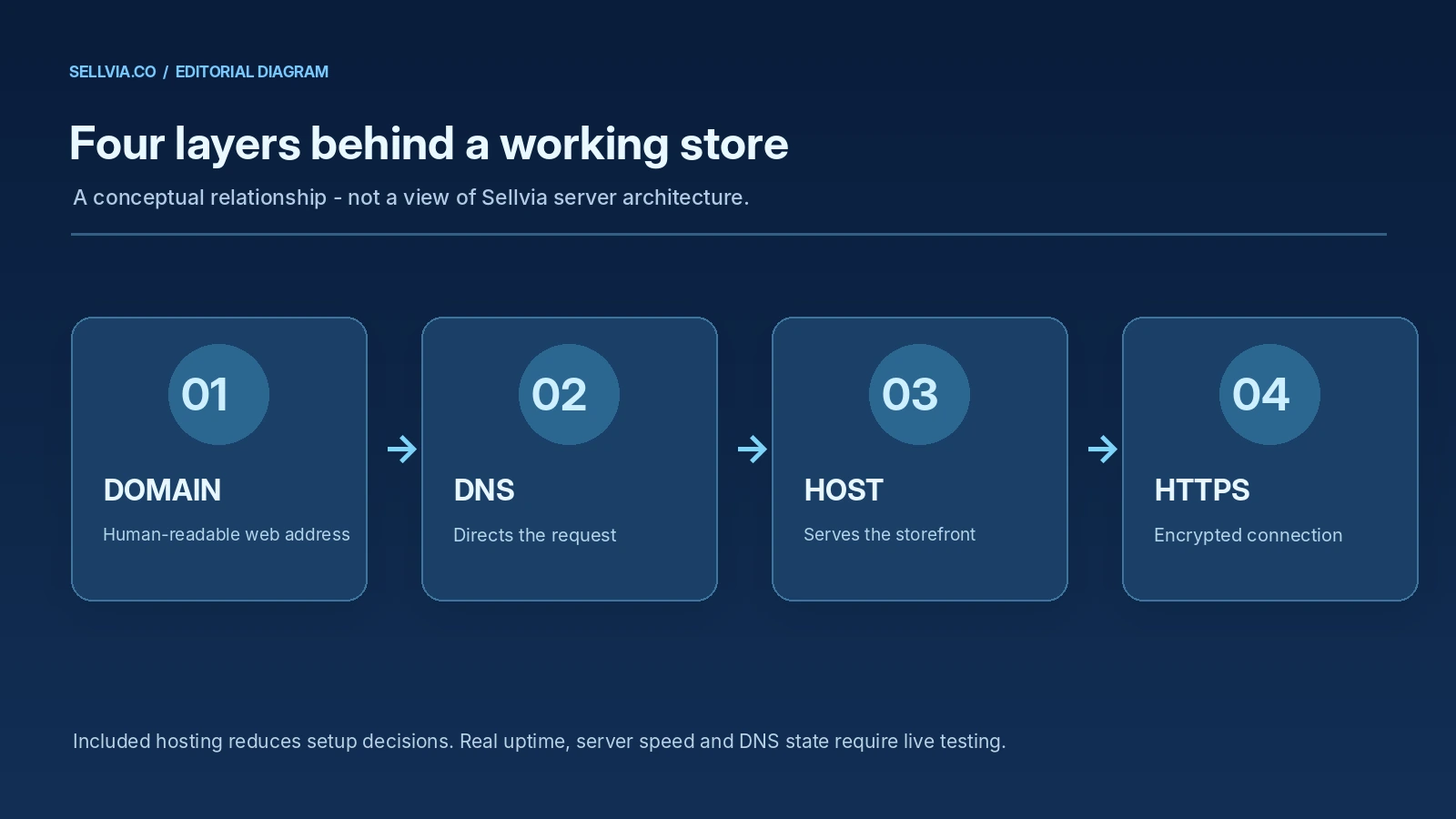
The current Terms of Use describe hosting within the free-turnkey-store creation package, alongside the storefront, initial products, an eligible domain, branded email, mailing setup and basic SEO metadata. The document also distinguishes included features from additional paid services. It does not supply an independently audited uptime percentage or a binding universal page-load time in the relevant feature list. Therefore, ‘hosting included’ is well supported; ‘guaranteed 99.99% uptime’ would not be supported by the same passage.
For a specific purchase, preserve the version of the offer displayed at signup. Check whether hosting is tied to an ongoing subscription, whether a custom domain is allowed and what happens to access when the plan expires. The distinction between hosting being bundled and hosting being owned is important. A managed service can be valuable precisely because the provider maintains the infrastructure. But a user should not assume that the underlying server account or installation can be transferred unchanged to another provider.
What setup work Sellvia can reduce
The most direct savings are in initial provisioning and coordination. With a functioning hosted storefront, a user does not have to create a new database, install a fresh copy of WordPress, attach a shopping theme or manually connect the required Sellvia environment as a first step. The user also has fewer separate vendors to contact about the basic site. A common source of first-week friction is a domain registered with one company, hosting purchased from another and a store-builder that expects different technical settings.
None of this removes the owner’s responsibility for the business. The storefront still needs accurate text, suitable product descriptions, public contact details and clear policies. A visitor-facing failure should still be reported and followed through. The real improvement is that several technical prerequisites are packaged together. For an owner whose comparative advantage is customer research or content, that is a credible reason to value a turnkey model.
A concrete handover test for hosting
Once a customer receives the store address, the first test should be deliberately simple: open the URL in a private browser window on a normal connection. Does the expected storefront appear? Does the browser reach a secure HTTPS version? Does an accidental www variation lead somewhere sensible or produce an error? Does the homepage still load on a phone using mobile data? These checks establish availability for the person receiving the service, not uptime over the preceding month.
Next, follow the main menu, open at least one category and one product page, and revisit the homepage. A server that answers the front page but fails on deeper pages is not a satisfactory handover. Save the tested URLs and the date. If something fails, capture the actual error and report it to support without assuming the origin. The fault could involve hosting, DNS, an application plugin or a temporary network issue. Good support diagnosis depends on distinguishing them.
HTTPS and SSL: what a browser padlock proves
TLS protects the connection between a visitor’s browser and the website. For a public store, valid HTTPS is an essential baseline because customers should not be asked to interact with a site that triggers security warnings. Some Sellvia promotional material says SSL is included. In an actual evaluation, the decisive evidence is the browser’s connection details and the certificate returned for the specific public domain. We have not checked a private customer domain in this article.
A certificate verifies that the connection is encrypted and that the domain’s certificate validates according to the browser. It is not a general seal of commercial legitimacy and does not prove that a product is high quality. A clean test includes checking the canonical domain, any redirect from HTTP, certificate expiry and obvious mixed-content warnings. If the site supports a custom domain, repeat the check after the DNS change because a correctly configured original address does not automatically prove a new hostname is ready.
Domain connection is part of the hosting experience
The published package includes an eligible domain unless the customer selects a premium domain or uses a different domain option. Hosting becomes useful to the visitor only once the public domain resolves to the appropriate site. In practical terms, the hostname is the front door while the host supplies the building behind it. Managed onboarding may make the connection less visible to a beginner, but it remains a real technical dependency.
When reviewing a delivered store, check the exact public address, including any redirects, and record the domain’s renewal and management terms separately from the site subscription. If an owner later changes a domain, DNS propagation and certificate issuance may produce a transition period. The useful service-quality question is whether Sellvia provides a clear supported path for that change and resolves errors promptly, not whether DNS behaves instantaneously everywhere.
Site speed: measure rather than assume
A page may feel fast on one machine because a browser cached images. It may load differently for a new mobile visitor. We would assess real-world speed with a defined URL, device profile, network conditions, geographic testing point and measurement date. Google’s PageSpeed Insights can help identify lab and field signals, but one score is not a property of the hosting provider alone. Large images, heavy scripts, a complex theme and third-party marketing tags can influence results even when the underlying server is operating properly.
For an actual customer store, capture the homepage and a representative product page. Repeat measurements rather than relying on the first number. Note whether images dominate transfer size, whether scripts delay interaction and whether the server responds consistently. Do not interpret a high score as a guarantee of conversions; do not interpret a lower score as proof the host is defective. The positive case for bundled hosting is convenience. Speed should be evaluated against evidence from the specific deployed store.
Uptime is a time-series claim
Uptime describes availability across an interval. A page that loads now has demonstrated current accessibility, not a 30-day availability percentage. A serious evaluation should use independent monitoring from a reputable service, at a stated interval, for a known observation window. If a monitor checks only once an hour, it may miss short disruptions. If it uses a single region, it may report a regional network problem as if the whole service failed. Both limitations should be disclosed.
Without monitoring records, we do not publish a numeric uptime rating for Sellvia hosting. That does not prevent a positive editorial judgment about the included infrastructure. It means the judgment is properly scoped: hosting is integrated into the starting package, which reduces setup complexity. Availability performance remains an open empirical question for the particular store. This level of precision makes an assessment more valuable than generic claims of ‘rock-solid hosting’ with no test record.
Backups and restore responsibilities
A hosted store contains configuration and customer-facing content that can take time to reconstruct. One of the most important questions to ask support is how backups work: what is covered, how often copies are made, how restoration requests are initiated and what records the user can export independently. The published free-store inclusion of hosting should not be treated as proof of a specific backup cadence or retention period. Those details require documentation or a written support response.
A practical owner can still keep a simple inventory of brand assets, approved product copy, custom designs and key records, provided this is allowed by the applicable terms. The objective is not to self-manage every server component. It is to understand the boundary between Sellvia’s service responsibilities and the user’s information-preservation responsibilities. A clear backup and recovery policy can be an important part of a premium managed-hosting experience; an actual audit must establish it rather than guess it.
Security includes more than a certificate
Good operational security involves supported software, restricted account access, sensible authentication, vulnerability handling and disciplined updates. Hosting alone does not prove the quality of those procedures. To assess Sellvia’s managed environment responsibly, ask which security functions the provider manages and what the store owner must do: for example, maintain unique passwords, protect email access and report suspicious activity. Avoid publishing internal security claims that cannot be supported by documentation or authorized testing.
Independent security checks should remain non-invasive. A browser-level review can look for certificate errors, insecure asset loads and obvious public misconfiguration. It should not involve scanning private servers or attempting to access restricted interfaces. For the intended audience, the biggest usable advantage of an integrated service is that the provider can coordinate platform-level support. That advantage is strengthened when its support boundaries are clearly communicated.
Support ownership reduces finger-pointing
Consider a missing product image. On a custom stack, the cause could sit with the theme, a plugin, a CDN, the hosting cache or a DNS service. On an integrated platform, the customer has a clearer initial place to report the failure. That does not mean every fault is fixed immediately. It means the support journey can start without the owner first identifying which vendor is responsible. For beginners, that simplification can be as important as the initial setup savings.
A fair support evaluation would record the report time, the exact symptom, the first useful reply and whether the issue was resolved. It would also distinguish acknowledgement from resolution. We have not conducted such a timed hosting incident test for this article. Published reviews of Sellvia may help identify common experiences, but they do not establish a universal incident-response guarantee. Positive service assessment should be based on a documented outcome when available.
What an owner can and cannot assume they control
Managed hosting trades some infrastructure administration for convenience. That can be the right exchange for a beginner, but ownership expectations should be stated precisely. A subscription-based storefront is not necessarily the same thing as owning an independent hosting account and receiving all server credentials. The official terms describe a hosted service, and relevant licensing conditions govern how the customer may use it. The owner should verify which content, domain or design assets are separately controlled and what happens if the plan changes.
This is not an argument against Sellvia. A managed environment is appealing precisely because the provider handles important operational work. The key is matching the arrangement to the customer’s goals. Someone who wants minimal setup may value bundled hosting very highly. Someone whose business model requires unrestricted server-level access should clarify that requirement before subscribing. A positive review remains credible when it identifies the intended customer rather than pretending one hosting model suits everyone.
A hosting acceptance checklist
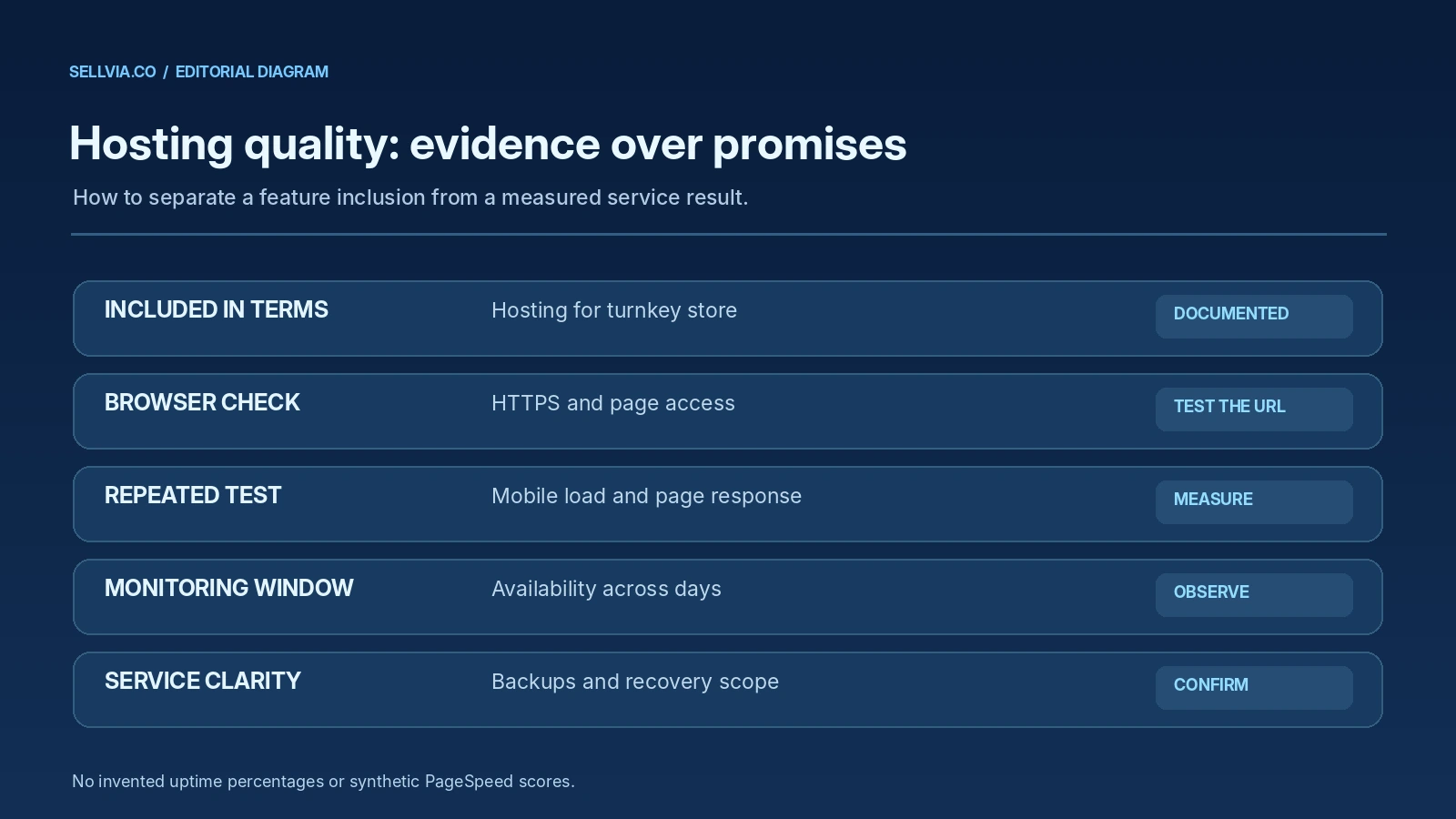
The following checklist is meant to be completed against the customer’s live store. Its blank status is intentional. We have not marked hypothetical tests as passed. Record a timestamp and supporting evidence for each result so that the same checks can be repeated after a domain change or site update.
| Test | What a pass means | Evidence |
|---|---|---|
| Public URL | Correct store opens reliably now | URL and date |
| HTTPS | Valid certificate and no warning | Browser security details |
| Navigation | Homepage and product pages load | Representative page links |
| Mobile view | Layout works over mobile data | Phone screenshots |
| Speed | Repeatable measurements recorded | PageSpeed or equivalent report |
| Availability | Monitoring window established | Uptime log and test interval |
| Support | Clear route for a hosting problem | Published contact route or ticket |
| Recovery | Backup responsibilities clarified | Written help article or response |
The checklist also provides an owner’s first support message. Instead of asking why ‘the hosting is bad’, the owner can identify the failing URL, exact symptom and conditions. That is an efficient way to turn a general infrastructure promise into a verifiable service experience.
Editorial verdict
Sellvia’s inclusion of hosting is a meaningful benefit within its turnkey-store package because it eliminates a major category of early configuration work. The Terms of Use provide direct support for that conclusion. The arrangement should appeal most to buyers who want a prepared WordPress storefront and do not want to make hosting administration their first project. A well-documented handover, working HTTPS and responsive support would strengthen that advantage further when demonstrated in a specific account.
Our verdict is positive about convenience and integration. It is not a fabricated benchmark of uptime, server speed, backups or recovery. Those are important quality dimensions and deserve actual test results, not adjectives. For a wider explanation of the platform, see our Sellvia platform overview; for the scope of subscription plans, consult Sellvia Pricing Explained.
Frequently asked questions
Does Sellvia provide hosting with a turnkey store?
Yes. The free-turnkey-store section of its published Terms of Use lists hosting as an included component. The conditions of use and continued access remain subject to the applicable subscription and service agreement.
Does ‘hosting included’ mean unlimited traffic?
No such inference follows from the inclusion itself. To assess capacity, consult the relevant service documentation or support and, where permitted, use controlled testing. We have not verified a numeric visitor limit or throughput level here.
Is SSL guaranteed to work on my custom domain?
Some company materials discuss SSL, but the appropriate verification is a real HTTPS check after the custom domain is connected. The certificate must validate for the exact hostname used by visitors. A new domain should always be tested.
What if my store loads slowly?
Record the full URL, device, approximate location, time and whether the issue affects multiple pages. Compare repeated measurements and image sizes, then contact Sellvia support with the evidence. One slow load does not identify the cause by itself.
Are backups and restoration included?
The hosting inclusion does not, on its own, specify backup frequency or restoration terms. Request the applicable current policy or a written support clarification for the account before making business-continuity assumptions.
Did this article independently measure Sellvia server performance?
No. This is a review of the documented service proposition, with a reproducible technical test framework. We did not use a private customer store or claim invented uptime, response-time or security results.
Sources and review methodology
The central contractual reference is Sellvia Terms of Use, particularly the free-turnkey-store section. For generally applicable HTTPS and site-performance methodology, see Google’s Web Vitals guidance and MDN’s TLS overview. We also considered the limits of public user ratings on Capterra: they are not a substitute for testing the particular host. The illustrations are original conceptual diagrams; none is a monitoring screenshot from a customer account.

Robert Gross is a contributing writer at Sellvia.co with a strong interest in ecommerce operations and the economics behind digital selling platforms. His articles examine how Sellvia’s tools work together in real business scenarios, including store setup, advertising, order processing, performance tracking, and cash-flow planning. Robert focuses on the operational details that are often overlooked, helping readers form realistic expectations, recognize potential challenges, and approach online business decisions with greater clarity.
Leave a Reply