Quick answer. The most defensible reason to consider a Sellvia turnkey store is not that a finished site guarantees customers. It is that Sellvia packages several normally separate setup decisions into one starting point: a WordPress storefront, platform access, hosting, an eligible domain, one branded email address, an initial group of catalog products, mailing setup and basic SEO metadata. These elements are specified in Sellvia’s Terms of Use. Our editorial assessment is positive about the convenience of that combination. This article examines what that promise actually means at handover, what deserves inspection and what cannot be verified without access to a particular delivered store.
An audit of readiness, not an invented success story
A store can look finished in a promotional photograph yet still need work before a visitor can buy confidently. Equally, a business can have a technically functioning storefront and not have a viable marketing plan. A quality audit has to separate these states. We judge the handover package, the clarity of the visitor journey, the consistency of store content, the seller’s control over brand information and the evidence available for each claim. We do not rate profitability, advertising performance or the speed of a private store we cannot inspect.
Our documentary starting point is Sellvia’s current Terms of Use, labelled updated July 2026 at the time of editorial review. Its section on a free turnkey store lists a WordPress site with the Sellvia platform plugin and hosting. The same terms list an included domain subject to selection, a branded email address, catalog access, 50 products initially uploaded, mailing-service setup and basic SEO metadata. These are commitments in published documentation, not results of an independent account walkthrough. The distinction matters: we can verify what is described, but only delivery records and access to a real store can show whether every promised item arrived correctly.
What the published turnkey package contains
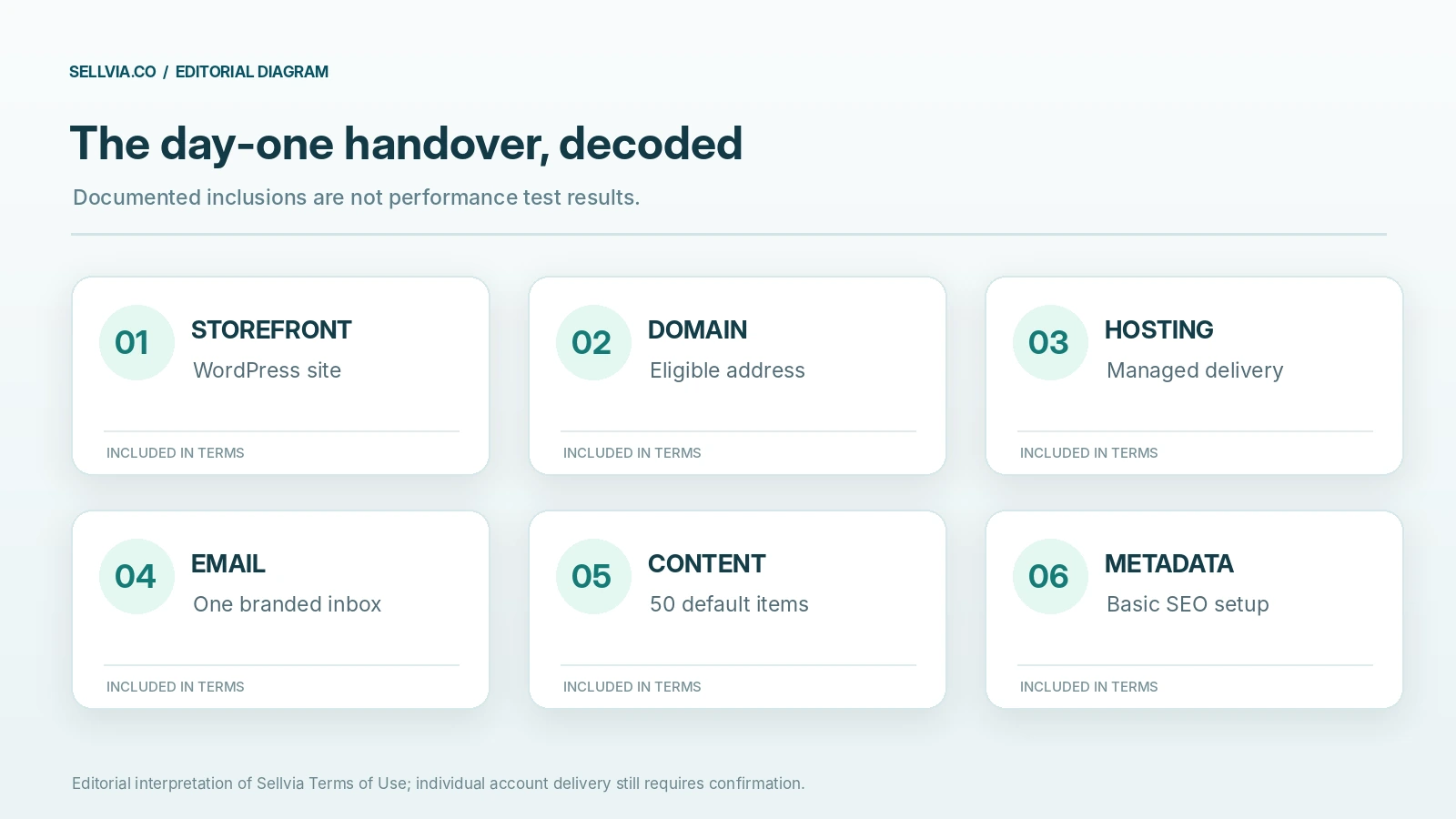
The useful way to read a feature list is to connect each entry to a task it removes. A provided store structure means the owner does not need to begin with an empty content-management system. Included hosting reduces the need to choose and provision a separate server. A domain helps establish a memorable public address. A branded mailbox gives support communication a store-specific identity. Catalog access supplies the starting source of product listings, while initial metadata creates a basic search-facing foundation.
| Documented component | Practical benefit | What remains to verify |
|---|---|---|
| WordPress-based storefront and Sellvia platform plugin | A coherent site starting point | Correct pages, navigation and functionality |
| Hosting | No separate hosting purchase to begin | Live availability, HTTPS and response time |
| Eligible domain | A public brand address | Ownership terms, renewal and DNS status |
| One branded address | Business-facing contact identity | Access, sending, delivery and recovery |
| Catalog access and 50 default products | A populated first view | Relevance, content quality and product details |
| Mailing setup and basic SEO metadata | Less initial configuration | Working forms and accurate metadata |
This table is a map of the offer, not a claim that every individual account has already passed testing. Sellvia also sells optional upgrades. A premium domain, paid theme, catalog expansion or marketing package should not be quietly counted among the free baseline features merely because it appears during the same signup journey.
Why a prepared structure is genuinely useful
Many beginners spend their earliest working days resolving interdependencies rather than making decisions about the store itself. A domain needs to reach a host. A host must serve a site. Pages need a menu, mobile layout and recognizable identity. A store needs something to display. Contact details must work. Solving these one at a time can be rewarding for a developer but distracting for someone who simply wants to evaluate an ecommerce concept. A turnkey package creates a logical initial sequence and reduces the number of providers that must be coordinated.
This is where Sellvia has a credible advantage. Its value proposition concerns the assembly of an operating environment, not just a theme or a checkout button. The real benefit is fewer independent technical decisions before the first customer-facing inspection. That does not mean the owner should publish without review. It means the review starts with an existing structure and a shorter list of exceptions. The difference is especially meaningful for a first-time owner who needs a clear starting line rather than another collection of disconnected tools.
The public homepage: the first five seconds
A professional storefront should answer three questions quickly: what this shop sells, why the offering is relevant and what a visitor should do next. A polished theme does not guarantee those answers. We recommend testing the first screen without reading an instruction manual. Is the main category clear? Are the first product images consistent in style? Does the primary call to action explain the next step? Is the menu understandable without unexplained labels or duplicated links? A stranger should be able to orient themselves without asking who built the store.
The most useful editorial test is not to award points for visual decoration. Give a new visitor the public URL, ask them to identify the main offering and observe where they click. If the store loads and the navigation is coherent, that is a real positive outcome. If the visual presentation is generic, the owner can prioritize branding edits before spending on promotion. In either case, the existence of a prepared homepage moves the work from building an initial skeleton to improving an actual customer journey.
Product pages deserve their own inspection
Sellvia’s published terms identify 50 randomly selected products as the initial default for the free turnkey store. That is a helpful starting population but not necessarily a curated collection for a particular niche. Random selection should be read literally. Before publishing, check whether titles are understandable, descriptions explain what the buyer receives, images match the item, categories are appropriate and any delivery language fits the actual product format. A store with fifty listings can still feel less convincing than one with ten consistent listings.
A useful sampling method is to select five items from different categories and read each page on both desktop and mobile. Look for unfinished template text, broken media, conflicting prices or a call to action that behaves unexpectedly. When products are digital, inspect download or access language rather than assuming shipping procedures apply. If a storefront is configured under a partner model, confirm which site completes the transaction. This is not a broad tutorial about catalog management; it is a quality-control procedure for an already delivered shop.
The 50-product figure and larger promotional claims
One information gap is how different Sellvia pages describe initial product counts. Its Terms of Use specify fifty randomly selected products for the free turnkey store, while certain promotional pages refer to substantially larger catalogs or preloaded assortments. These statements may concern different offers, campaigns, plans or time periods. It would be careless to select the most attractive number and present it as the universal standard. Our editorial baseline is the product count stated in the terms associated with the relevant offer and the actual account handover.
A buyer should save the exact signup page, offer confirmation and order summary. When the store becomes available, compare the inventory count with those records. If an advertisement promises a special bundle, ask support whether it applies to the specific subscription and whether the products are already installed or merely available for import. This level of precision makes a positive review more convincing: it identifies a meaningful catalog advantage without turning marketing copy into an unsupported guarantee.
Navigation, essential pages and trust signals
Store quality is often decided in unglamorous places. Test the navigation menu, footer and at least one product category. Confirm that the contact route works and the store has appropriate policies or explanatory pages for its operating model. Check whether the business name, customer-facing email and public contact information are consistent. Review every prominent button, especially those leading to checkout or a separate marketplace. A visually impressive header cannot compensate for a broken visitor path.
It also helps to distinguish template presence from legal completeness. A contact page may exist but still contain incorrect information. A generic policy may not address the actual seller of record or the nature of the product. Sellvia’s managed approach can simplify assembling these elements, but the owner still has to check their accuracy for the relevant country and commercial model. Our positive assessment therefore concerns the prepared structure and reduced setup burden, not an automatic certification of legal compliance.
What should happen at checkout?
For a quality audit, completing a purchase journey is more informative than looking only at a static product page. However, different Sellvia arrangements may handle checkout differently. Under a partner storefront arrangement, a shopper can be directed to Sellvia Mall for the final transaction. Under a model with customer-managed payments, the seller’s own payment arrangement creates a different operating boundary. An audit must identify the model before calling the path correct or incorrect.
Without a test transaction we can still verify what the terms say, but we cannot pretend we inspected an individual payment flow. For an actual store, follow the action from a product page through the next screen without submitting a purchase. Note domain changes, visible merchant information, product consistency, pricing and customer expectations. This test has immediate practical value: it helps a store owner present the purchasing experience accurately and avoid promising a self-hosted checkout that their arrangement does not provide.
Visual polish versus brand specificity
A professionally built initial theme is a better starting point than an empty theme with placeholder headings. But good design and differentiated branding are separate achievements. Check whether the store name is visible, colors feel consistent, typography is legible and product imagery looks like one catalog rather than a set of unrelated advertisements. Inspect a narrow phone viewport, not only a large desktop screenshot. Buttons should remain visible and text should not overlap images.
Sellvia offers choices and optional upgrades, but the specific scope of changes depends on the plan and service. We would not assert that every field is fully editable from the dashboard. For fields such as legal details or contact information, verify whether a direct setting or a support-assisted update is available. The editorial advantage is still real: starting with an assembled storefront is efficient. The essential follow-up is to identify which edits are self-service and which are requests to the provider.
Basic SEO metadata: foundation rather than ranking promise
The included basic SEO metadata is a sensible part of a handover package. Titles and descriptions give search engines and users context about pages, although Google can rewrite snippets and ranking depends on many additional factors. A quality auditor should inspect a few public page titles and meta descriptions, look for obvious duplication and confirm that important pages can be reached through internal links. A basic technical foundation is useful even before a long-term content strategy exists.
Do not call a store ‘SEO optimized’ solely because it contains metadata. Indexability, quality content, speed, intent alignment, internal links and search demand deserve independent examination. Our separate article on Sellvia’s platform explains the broader workflow; here the narrower question is whether an owner receives a reasonably organized starting point. The answer from the documented package is encouraging, subject to verifying the delivered page output.
A practical day-one acceptance checklist
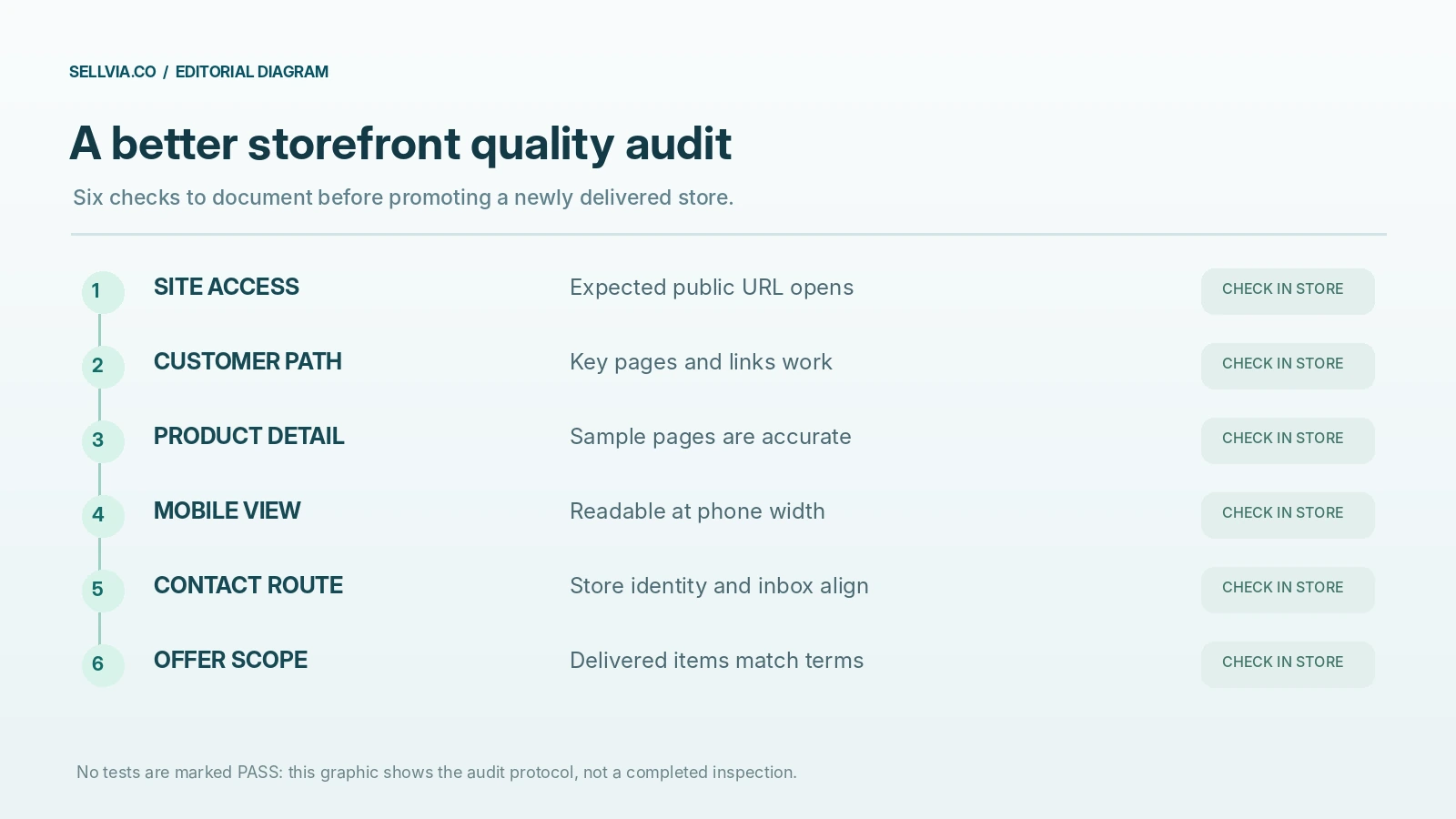
The following is a reproducible editorial protocol, not a description of a test already completed. First, open the public address in a private browser session and confirm the correct store loads. Second, inspect the homepage on desktop and mobile. Third, follow all principal menu destinations and one product path. Fourth, sample five listing pages for completeness. Fifth, check the contact channel and any public policy links. Sixth, record whether checkout continues on the expected domain for the account’s operating model. Finally, save the subscription offer and compare it with the received components.
| Area | Pass condition | Evidence to keep |
|---|---|---|
| Access | Correct domain and working pages | URL and timestamped screenshots |
| Presentation | Readable layouts across screen sizes | Desktop and mobile captures |
| Catalog | Accurate titles, images and descriptions | Five sampled product URLs |
| Navigation | No dead primary journeys | Link-check log |
| Identity | Consistent brand and contact information | Contact page and mailbox notes |
| Scope | Delivered assets match the offer | Offer and account confirmation |
This approach is more useful than calling a store ‘excellent’ after glancing at a homepage. It makes quality observable and shows an owner exactly where the remaining work is located.
A fair editorial scorecard
A useful scorecard should distinguish included features from demonstrated quality. We would weight public functionality and consistency more heavily than superficial effects. Store access and navigation could make up 25% of an individual audit; product-page accuracy 25%; mobile usability 20%; brand and contact consistency 15%; and clarity of the delivered offer 15%. These are editorial weights suggested for future tests, not scores already earned by Sellvia. They help reviewers avoid changing criteria depending on whether they like the design.
The strongest result would be an audit in which a store passes every required visitor path and the reviewer can cite screenshots and timestamps. A store that needs one branding correction can still be a valuable turnkey product. A site with inaccessible checkout needs more work even if its graphics look attractive. This method allows an evidence-based positive verdict while making outstanding issues visible and correctable.
What this assessment has and has not verified
Verified from published terms: the documented free-turnkey package includes a WordPress-based site, Sellvia plugin, hosting, an eligible domain, one branded address, catalog access, fifty initially uploaded products, mailing setup and basic SEO metadata. Not independently tested here: the appearance, uptime, speed, live checkout, DNS state, email delivery or exact product selection of a newly created private Sellvia store. A positive judgment about the integration of the offer should not be confused with a claimed hands-on benchmark.
We also checked the scope of existing articles in this publication. The broader How Does Sellvia Work? guide covers the workflow, while Sellvia Pricing Explained handles plan positioning. This piece addresses a different question: what quality evidence should exist on the day a turnkey store is delivered? Readers can use the acceptance procedure regardless of the plan variant they actually purchased.
Editorial verdict
Sellvia offers a convincing starting package for people who would rather evaluate an assembled ecommerce storefront than coordinate a build from zero. Its documented inclusion of hosting, a domain option, branded email and starter catalog content gives that judgment a concrete basis. The right way to strengthen the proposition is not to promise instant sales, but to inspect the delivered site as a working customer-facing product. A clean navigation path, coherent product pages and accurate brand details would turn the documented convenience into a demonstrably good handover.
Our assessment is favorable about the structure and practical time savings of the package. It is deliberately not a claim that a specific unobserved store passed every quality test. That boundary protects the credibility of the review and gives prospective users a useful standard for judging their own store.
Frequently asked questions
Is a Sellvia turnkey store really ready on day one?
The published package is designed to provide a prepared store with infrastructure and initial products. Whether a particular store is ready for public promotion should be determined by checking the supplied pages, contact information and customer journey. ‘Ready-made’ is a delivery model, not evidence of traffic or sales.
How many products are included in the starter store?
Sellvia’s July 2026 Terms of Use list fifty randomly selected items uploaded by default for the free turnkey store. Promotions can advertise other bundles, so the exact signup offer and delivered account inventory are the deciding evidence for a specific customer.
Does turnkey mean I never need to edit the store?
No. The core value is a prepared foundation. Branding, product relevance, customer-facing policies and navigation still merit inspection. Owners should also establish whether an edit is available directly or needs assistance from Sellvia support.
Does the included SEO setup mean Google will rank the store?
No ranking outcome follows automatically from basic metadata. The included setup is a useful foundation, but content quality, accessibility and competition still influence search performance. A live URL inspection is needed to check any specific store.
Is this article a hands-on performance test?
No. It is a documentary quality assessment plus a clearly specified acceptance-test protocol. We did not receive private store access, payment confirmations or server-monitoring records for a new store. We do not attribute invented measurements to Sellvia.
Sources and editorial method
The feature claims above are checked against Sellvia’s Terms of Use, updated July 2026. We distinguish published inclusions from live field tests throughout. For additional context about the broader product and published user impressions, see Capterra’s Sellvia review listing and our Sellvia Review. Illustrations in this article are original editorial diagrams, not screenshots of a Sellvia customer account.

Andrew Porter is an ecommerce writer and online business researcher at Sellvia.co. He focuses on Sellvia’s platform features, pricing, digital product tools, built-in advertising, order management, and payment processes. Andrew creates clear, research-based content that helps beginners understand how the platform works, assess the required budget, explore its advantages and limitations, and make more informed decisions about launching an online business.
Leave a Reply