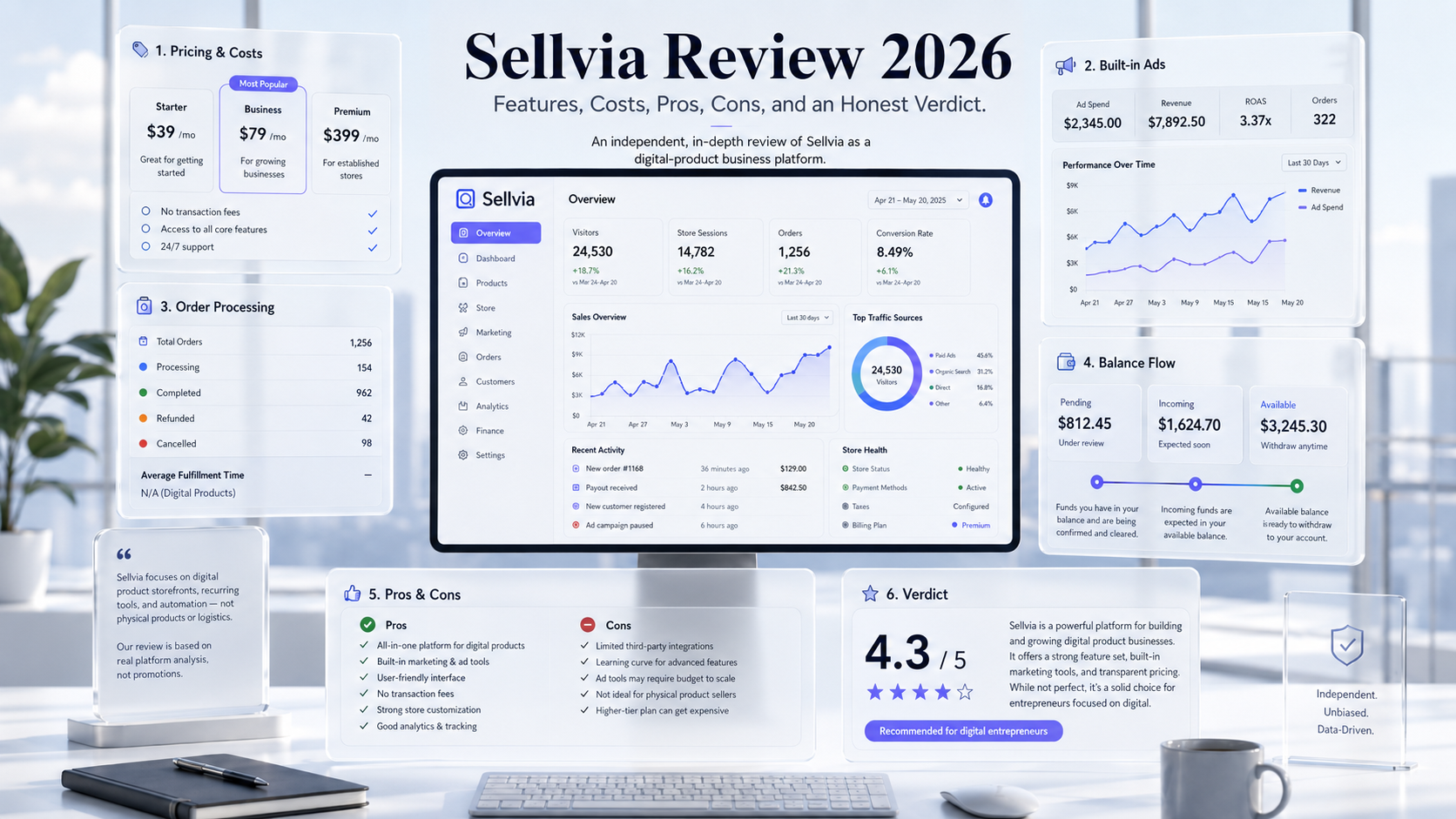
Most people researching Sellvia start with one question: how much does it cost per month. That question has a simple answer, and it is also the wrong place to stop. A subscription fee tells you what it takes to unlock the dashboard. It says nothing about what it takes to run a store that actually earns money, since advertising spend, order processing, and payout timing sit outside that number entirely.
This Sellvia review is built around the parts of the platform that determine whether a beginner’s experience is manageable or frustrating: how the store and product catalog work in practice, what built-in advertising really commits you to spend, how a commission on the dashboard turns into cash in a bank account, and how much capital you need on hand before any of that becomes predictable.
Sellvia Review at a Glance
| Category | Summary |
|---|---|
| Platform type | SaaS online business platform with a ready-made store and dashboard |
| Main product model | Digital products (guides, courses, checklists, templates, downloadable content) |
| Base subscription | $39/month as of July 2026, following a 14-day trial |
| Free trial | 14 days; verify current terms before signing up, since a payment method is typically required |
| Main operating expense | Built-in advertising, which typically exceeds the subscription cost |
| Order-processing requirement | Each order carries a processing fee (roughly 9.99% to 18%) and must be processed within 7 days or it is cancelled |
| Minimum payout | $100 available balance, confirmed in current Sellvia documentation |
| Best suited for | Beginners who want a structured system and can budget for advertising |
| Main limitation | Ongoing costs beyond the subscription and dependence on paid traffic |
| Overall assessment | A workable starting structure, not a low-cost or passive setup |
Bottom line: Sellvia removes a meaningful amount of technical setup work, but it does not remove the financial planning a new business owner needs to do. Anyone evaluating the platform should budget for advertising and processing costs separately from the subscription, and should treat the first weeks as a test rather than an assumed profit period.
What Is Sellvia Today?
Sellvia is a SaaS platform that gives a new user a functioning online store from the first day of sign-up. The store comes pre-loaded with a catalog of digital products, meaning the customer is not required to create their own content before they can start selling. This is a meaningful shift from how some older descriptions of Sellvia frame the platform, and readers researching the company through outdated articles may find a mismatch with what the dashboard looks like today.
Inside the account, a user has access to a product catalog they can add to their storefront, a built-in advertising system that connects to major traffic sources, an order management screen, performance reports, and a balance and payout area. Every one of these components sits inside the subscription. If you want a fuller walkthrough of account setup and the dashboard layout, our How Sellvia Works guide covers that in more depth than this review will.
One point that deserves early attention: the store, its catalog access, and its tools are provided as part of an active subscription, and access depends on keeping that subscription current, a point covered in more detail later in this review.
How We Evaluated Sellvia
Rather than walking through every dashboard menu, this review measures Sellvia against five practical questions a beginner actually needs answered before spending money:
- Setup simplicity – how much friction exists between sign-up and a functioning store
- Cost transparency – whether the true monthly cost is visible before a user commits
- Advertising dependence – how much of the business model relies on paid traffic
- Cash-flow requirements – how much working capital is needed before income and expenses line up
- Long-term operating control – how much of the business the user actually controls if they stop paying
These five lenses recur throughout the article so the review functions as a coherent framework rather than a disconnected list of features.
Getting Started With Sellvia
Account creation is straightforward: sign up, and the platform provisions a store automatically rather than asking the new user to design one from a blank template. During the trial period, a user can explore the dashboard, look through the available digital products, and get a sense of how advertising is activated. This is a genuine simplification compared to building an online store from scratch, and it addresses the setup-simplicity lens directly.
What is not simplified is judgment. A new user still has to decide which products to feature, how much to spend on advertising, and how closely to monitor early results. The platform reduces the technical barrier to starting, but it does not remove the decisions that determine whether a store performs well.
What a Beginner Still Has to Manage
- An advertising budget that is separate from the subscription fee
- Which products to promote and how to position them
- Timely processing of incoming orders
- Regular review of performance reports rather than assuming activity equals profit
- Enough working capital to cover advertising while earnings move through balance stages
- Awareness of payout timing so cash does not run short
None of this is unusual for an online business. The point of listing it here is that the sign-up process itself does not prepare a user for it, so this review is doing that instead.
Sellvia Products and Store Model
The catalog centers on digital products such as guides, checklists, templates, courses, and other downloadable material. Because delivery is digital, a store owner does not have to manage inventory or coordinate any kind of physical handling process, which is one of the more genuine conveniences of the model.
The catalog convenience comes with a trade-off. Since the products are supplied by the platform rather than created independently by the user, differentiation between one Sellvia store and another can be limited unless a user invests time in positioning, branding, or a narrower niche focus. Two stores drawing from the same catalog can end up looking similar to a shopper who visits both.
Before subscribing, users should confirm what happens to the storefront, catalog access, domain configuration, and account data if the subscription is cancelled. Sellvia’s own documentation states that a store becomes inactive immediately if a subscription payment is missed, and hosting and store access may be permanently removed after seven days of non-payment. The answer to any longer-term ownership question should come from the current Sellvia terms or direct support confirmation, not from an assumption of permanent ownership.
Sellvia Built-In Ads Review
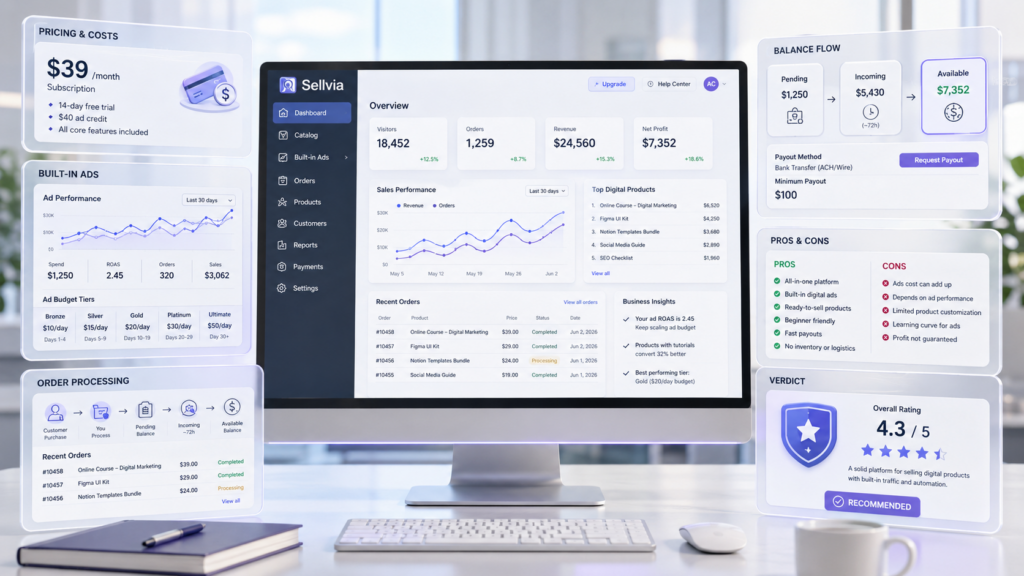
Built-in advertising is the part of Sellvia that most directly determines whether a store generates any orders, and it deserves more attention than the subscription price usually gets. The tool is designed to reduce the technical work of running campaigns across major channels, handling targeting and optimization on the user’s behalf rather than requiring the user to learn a separate advertising platform.
According to Sellvia’s current help documentation, campaigns start with a minimum daily advertising budget of $10. Higher budget levels become available after the ads have run continuously for specified periods: $15 after 5 days, $20 after 10 days, $30 after 20 days, and $50 after 30 days. Because the dashboard rules and upgrade process may change, users should confirm the current available level and billing settings directly inside their Sellvia Ads account.
Translated into simple monthly arithmetic, a sustained daily budget produces very different totals depending on the level chosen:
| Daily ad budget | Approximate 30-day total |
|---|---|
| $10/day | ~$300 |
| $15/day | ~$450 |
| $20/day | ~$600 |
| $30/day | ~$900 |
| $50/day | ~$1,500 |
These totals are simple arithmetic, not a projection of guaranteed spend or expected return. The point of showing them next to the subscription figure is that the subscription and the operating budget are two different numbers, and the second one is usually larger. Sellvia’s help documentation also confirms that a separate advertising service fee is charged on top of ad spend when this tool is used, so the amount billed can run higher than the daily budget alone.
What Sellvia Ads Simplify and What They Do Not Solve
The tool centralizes campaign creation, product selection, and performance reporting in one place, which removes a real learning curve for a beginner who has never run a paid campaign before. What it cannot do is manufacture demand for a product that does not resonate with buyers, or guarantee a particular conversion rate. Orders arriving from a campaign are not the same thing as profit; a user still needs to track cost per order against the margin earned on each sale to know whether a campaign is actually working.
Sellvia Pricing and the Real Cost of Operating
Sellvia’s cost structure has more layers than the headline subscription figure suggests: the base subscription, advertising spend, order-processing fees, optional performance tiers tied to order volume, working capital to cover expenses before revenue becomes available, and any payout-related fees. Our dedicated Sellvia Pricing breakdown covers each of these line items individually; this section focuses on why the combined total matters more than any single figure.
Consider a fully hypothetical monthly scenario, used only to illustrate how the math works:
| Item | Example only |
|---|---|
| Advertising spend | $600 |
| Orders | 30 |
| Average net commission per order before advertising | $25 |
| Total net commission (30 x $25) | $750 |
| Advertising cost per order ($600 / 30) | $20 |
| Illustrative result before subscription and other expenses ($750 – $600) | $150 |
Every figure in that table is a placeholder chosen to demonstrate the calculation, not a promised outcome. The subscription fee, any weekly performance tier, and payout-related fees still apply on top of this illustrative result, and none of them are included above. The formula worth carrying away from this example is:
Break-even cost per order = net commission per order minus processing and account-related costs.
As long as advertising cost per order stays below that break-even figure, the campaign is contributing to margin rather than eroding it. This is the calculation a beginner should run with their own real numbers, not the example numbers above.
A More Useful Question Than “How Much Does Sellvia Cost?”
The subscription price answers a narrow question. The more useful question is how much capital a beginner needs on hand before orders, processing costs, and payouts become synchronized with each other, since advertising spend happens continuously while commissions move through several stages before becoming available cash.
How Sellvia Orders and Balances Work
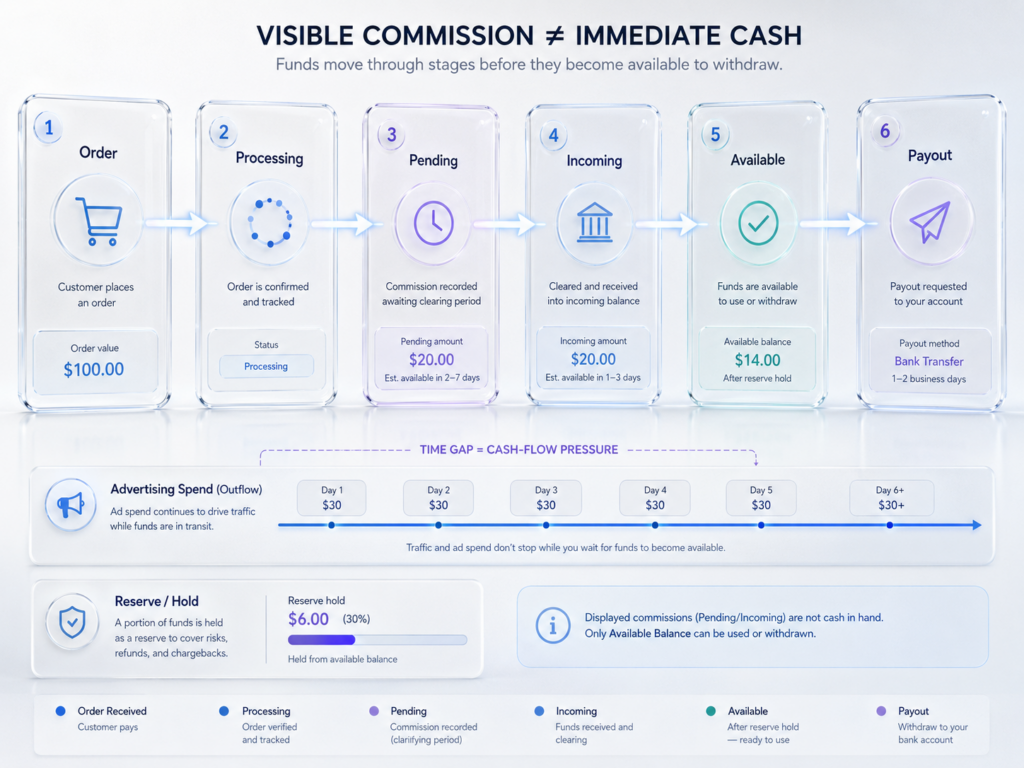
Understanding the order lifecycle matters more than most new users expect, because a visible commission is not the same thing as spendable money. According to Sellvia’s official order-processing documentation, a customer’s payment is added to the store owner’s balance, but funds only become available 72 hours after the order is processed, and orders left unprocessed for 7 days are automatically cancelled.
Sellvia’s help center confirms a $100 minimum before an available balance can be withdrawn or converted to Order Processing Credits, and describes a Risk Reserve, a portion of each commission held temporarily and released automatically after a documented holding period. Payout requests draw on the Available balance, and current fee schedules list options such as ACH and wire transfer, each carrying its own percentage-based fee and minimum charge. Since fee structures and hold periods are the kind of detail platforms adjust, always confirm the current numbers in the dashboard before relying on them for planning.
The Cash-Flow Issue Beginners Can Miss
Advertising spend does not pause while commissions sit in a pending or incoming stage. This creates a period where money is going out for traffic while the corresponding earnings are not yet withdrawable, which is a normal cash-flow characteristic of any business that pays for traffic upfront and collects revenue with a delay. The planning implication is that a user needs a cash buffer that covers this gap, not just enough money to cover the subscription and a single day of ads.
Sellvia Dashboard and Tools
Beyond advertising, the dashboard groups several functions that a store owner will use regularly. Our Sellvia Tools overview covers each in more detail; the summary below focuses on practical value.
| Tool | Main purpose | Practical value | Main limitation |
|---|---|---|---|
| Product catalog | Add digital products to the store | Removes the need to create content from scratch | Shared catalog can limit differentiation |
| Built-in ads | Launch and manage paid traffic | Centralizes campaign setup and reporting | Does not guarantee profitable performance |
| Order management | Process incoming customer orders | Keeps fulfillment steps in one screen | Requires timely action or orders may be cancelled |
| Performance reports | Track sales and ad activity | Gives visibility into what is happening | Interpreting the numbers is still the user’s job |
| Balance tracking | Show pending, incoming, and available funds | Clarifies where money is in the process | Does not speed up the underlying timelines |
| Payout requests | Withdraw available funds | Straightforward once the threshold is met | Minimum thresholds and timing apply |
What Sellvia Does Well
Sellvia’s structured workflow gives a genuine beginner a clear sequence of steps rather than an open-ended set of choices, which lowers the odds of getting stuck before ever launching. Having the store, catalog, advertising controls, and order management inside one platform also reduces the number of separate tools a new user would otherwise need to learn, and the absence of physical handling requirements removes a category of operational complexity that trips up many first-time online sellers.
Where Sellvia Has Limitations
Order-processing obligations and payout timing add a layer of cash-flow planning that a beginner might not anticipate from the sign-up page alone, and because platform-provided assets sit inside the subscription relationship, users have less independent control over the store than they might with a fully self-built alternative. None of this makes Sellvia illegitimate, but profitability is not guaranteed, and current rules can shift, so ongoing verification matters.
Sellvia User Reviews: What Feedback Commonly Focuses On
To identify recurring feedback patterns, this review looked at recent public feedback on Trustpilot, Capterra, and the Better Business Bureau. Individual reviews are anecdotal and do not represent every account, and rating aggregators can be affected by incentivized submissions on either side, so the themes below are presented as patterns rather than confirmed universal outcomes.
Common Positive Themes
- Straightforward account setup and store provisioning
- A dashboard that is approachable for people without a technical background
- Responsive support during onboarding, with several reviewers noting fast replies from assigned account contacts
- Convenience of having products, ads, and orders in one place
Common Concerns
- Total spending ending up higher than expected once advertising and processing costs are included
- Confusion about processing costs before the first order arrives
- Uncertainty about payout timing relative to when a sale is made
- Questions about the cancellation process and unexpected renewal charges
These patterns should be read as recurring themes, not universal outcomes. For a broader collection of user experiences, our Sellvia Reviews hub gathers more perspectives than a single article can cover.
Is Sellvia Legit?
Sellvia is an operating platform with a public website, an account dashboard, published subscription terms, documented order and payout procedures, and a support system, all of which are the basic markers of a real, functioning service rather than a shell operation. Legitimacy in this sense, however, is separate from profitability. A platform can be entirely real and still not produce a profitable outcome for every user, because that depends on advertising performance, product choice, and financial discipline rather than the platform’s existence. Anyone evaluating this question in more depth should look at current pricing, processing rules, and cancellation terms directly rather than relying on a single review.
Is Sellvia Worth It?
Whether Sellvia is worth considering depends on the user’s situation. It may suit someone who wants a structured, centralized system, is comfortable treating advertising as a required ongoing expense, has a realistic testing budget set aside, and understands that a commission on the dashboard is not yet cash in a bank account. It is a poorer fit for someone expecting income without an advertising budget, without a cash reserve to cover the payout gap, or expecting a guaranteed result rather than a business that requires monitoring and adjustment.
Sellvia for Beginners: A Practical Decision Checklist
Sellvia Pros and Cons
| Pros | Cons |
|---|---|
| Store and product catalog are ready from day one | Subscription price does not reflect the full operating cost |
| No physical inventory or shipping process to manage | Advertising is a required, ongoing expense in practice |
| Advertising, orders, and reports live in one dashboard | Commissions pass through pending and incoming stages before becoming available |
| Lower technical barrier for first-time store owners | Store assets sit inside the subscription relationship |
| Transparent balance stages once you understand them | Profitability is not guaranteed and depends on user decisions |
Final Verdict
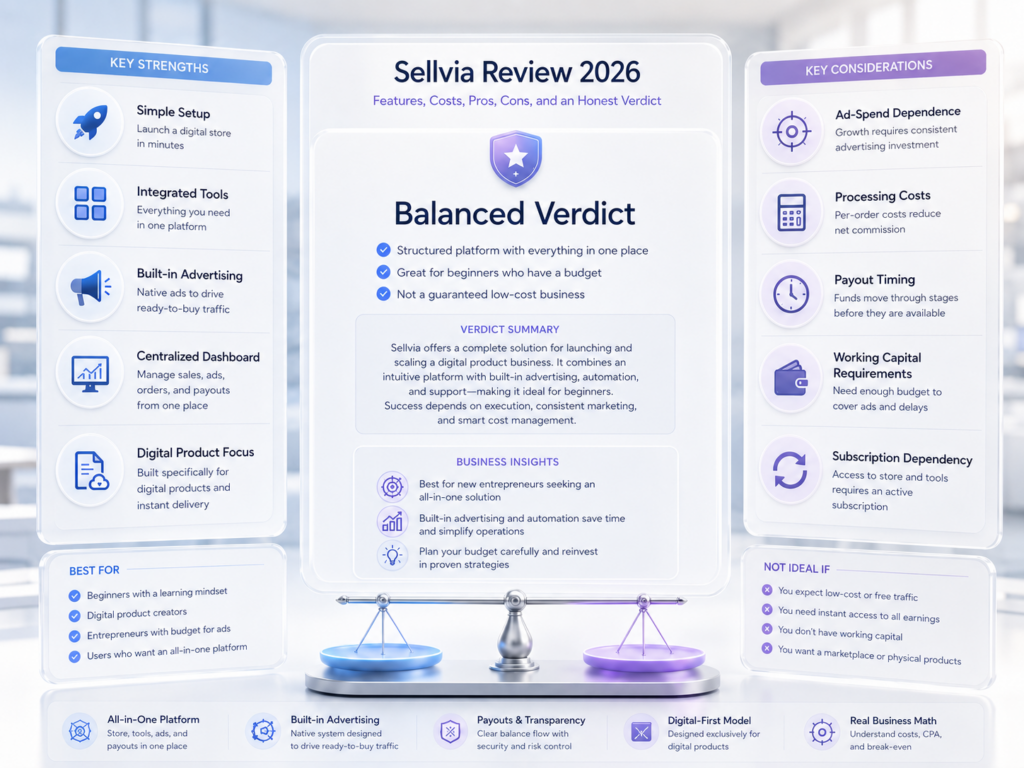
Sellvia functions as a structured operating system for a specific kind of digital-product business, and it genuinely lowers the technical barrier to getting a store online. What it does not do is remove the underlying economics of running a business that depends on paid traffic: advertising costs money on top of the subscription, orders require processing, and cash moves through several stages before it is available to spend.
Someone considering Sellvia should treat the subscription price as the smallest number in the equation, not the whole equation. It is worth considering for a beginner who can set aside a realistic testing budget and is willing to track cost per order rather than order volume alone. It is a weaker fit for anyone expecting a low-cost, guaranteed-income setup, since that expectation does not match how the platform operates. The most balanced approach in 2026 is to budget deliberately, monitor performance honestly, and verify current pricing and rules directly before committing further capital.
Looking for the main overview? Visit our Sellvia guide for pricing, tools, reviews, costs, and a clear explanation of how the platform works. You can also browse All Sellvia Articles for deeper breakdowns of specific topics covered briefly here.
Frequently Asked Questions
What is Sellvia?
Sellvia is a SaaS online business platform that provides a ready-made store, a catalog of digital products such as guides and courses, built-in advertising, order management, and a payout system. Users do not need to create their own products, since the catalog is supplied by the platform, but they do need to manage advertising, order processing, and cash flow themselves.
How much does Sellvia cost?
The base subscription is $39 per month as of July 2026, following a 14-day trial. This figure does not include advertising spend, order-processing fees, or optional performance tiers, which together typically cost more per month than the subscription itself.
Does Sellvia offer a free trial?
Yes, Sellvia offers a 14-day free trial with access to the store, dashboard, and product catalog. A payment method is typically required to start the trial, and the subscription renews automatically afterward unless cancelled, so confirm the current terms before signing up.
How do Sellvia built-in ads work?
The tool manages campaign creation and optimization across major channels on the user’s behalf. Campaigns start at a $10/day minimum, and the daily budget increases automatically at set milestones as performance data accumulates. Advertising is billed separately from the subscription and does not guarantee a result.
How are Sellvia orders processed?
When a customer places an order, the store owner processes it and pays the associated processing fee, which Sellvia documents as roughly 9.99% to 18%. Orders left unprocessed for 7 days are automatically cancelled, so timely processing is necessary to keep the sale and start the balance-release timeline.
How do Sellvia payouts work?
Funds become available 72 hours after an order is processed, and a $100 minimum balance is required before a payout can be requested. A portion of each commission is held as a Risk Reserve and released automatically after a documented holding period. Payout methods and their fees should be confirmed directly, since these details can change.
Is Sellvia legit?
Sellvia is a functioning platform with a public website, dashboard, documented terms, and a support system, which are the basic markers of legitimacy. That said, being a real platform does not guarantee that any individual store will be profitable, since results depend on advertising performance, product selection, and financial planning rather than the platform’s existence alone.
Is Sellvia worth it for beginners?
Sellvia can be worth considering for beginners who are prepared to budget for advertising separately from the subscription, who understand order processing and payout timing, and who treat the first month as a test period. It is a weaker fit for anyone expecting guaranteed income or a very low total operating cost.

Andrew Porter is an ecommerce writer and online business researcher at Sellvia.co. He focuses on Sellvia’s platform features, pricing, digital product tools, built-in advertising, order management, and payment processes. Andrew creates clear, research-based content that helps beginners understand how the platform works, assess the required budget, explore its advantages and limitations, and make more informed decisions about launching an online business.


Leave a Reply