
A virtual spokesperson can be useful without pretending to be a real creator. That is the interesting part of Sellvia's AI Influencer Subscription. Instead of buying a promise of instant followers, the customer is buying access to digital marketing material built around an AI-generated persona. The distinction matters. A downloadable video and a matching caption are tangible assets; social reach is a separate challenge requiring distribution, editing, judgment, and consistency.
For this editorial review, I looked at the subscription's publicly described scope and compared it with the everyday decisions a small digital-product store actually faces. My favorable assessment comes from the structure of the offer: it makes recurring social content more accessible to owners who do not want to record themselves. It is most compelling when the buyer treats the package as a production shortcut, not an outsourced marketing department.
Start with the deliverable, not the word influencer
The word influencer usually suggests an existing audience, a recognizable person, and the possibility of borrowing that person's credibility. Sellvia's AI persona is different. It is a synthetic character represented through videos and related media. The persona does not arrive with a transferable audience, independent followers, or the authority of an actual human recommendation. That narrower framing makes the offer easier to evaluate fairly.
What matters is whether the supplied assets let a store publish more useful content with less production work. I would rather receive three coherent clips with readable captions than a folder full of generic assets that nobody can adapt. Good content should be judged at the moment a viewer sees it in a feed, not by the number printed on a sales page. A repeated character can provide visual continuity, but its story, topic and relevance are still the merchant's responsibility.
The service makes particular sense for a digital catalog of courses, guides and templates. An AI presenter can introduce a lesson, surface an audience question, or guide viewers toward a useful educational topic. The video should not invent a buyer testimonial or claim personal experience with a program that the virtual character could never have used. Strong creative direction is more persuasive than pretending the character has a personal history.
What the subscription is designed to supply
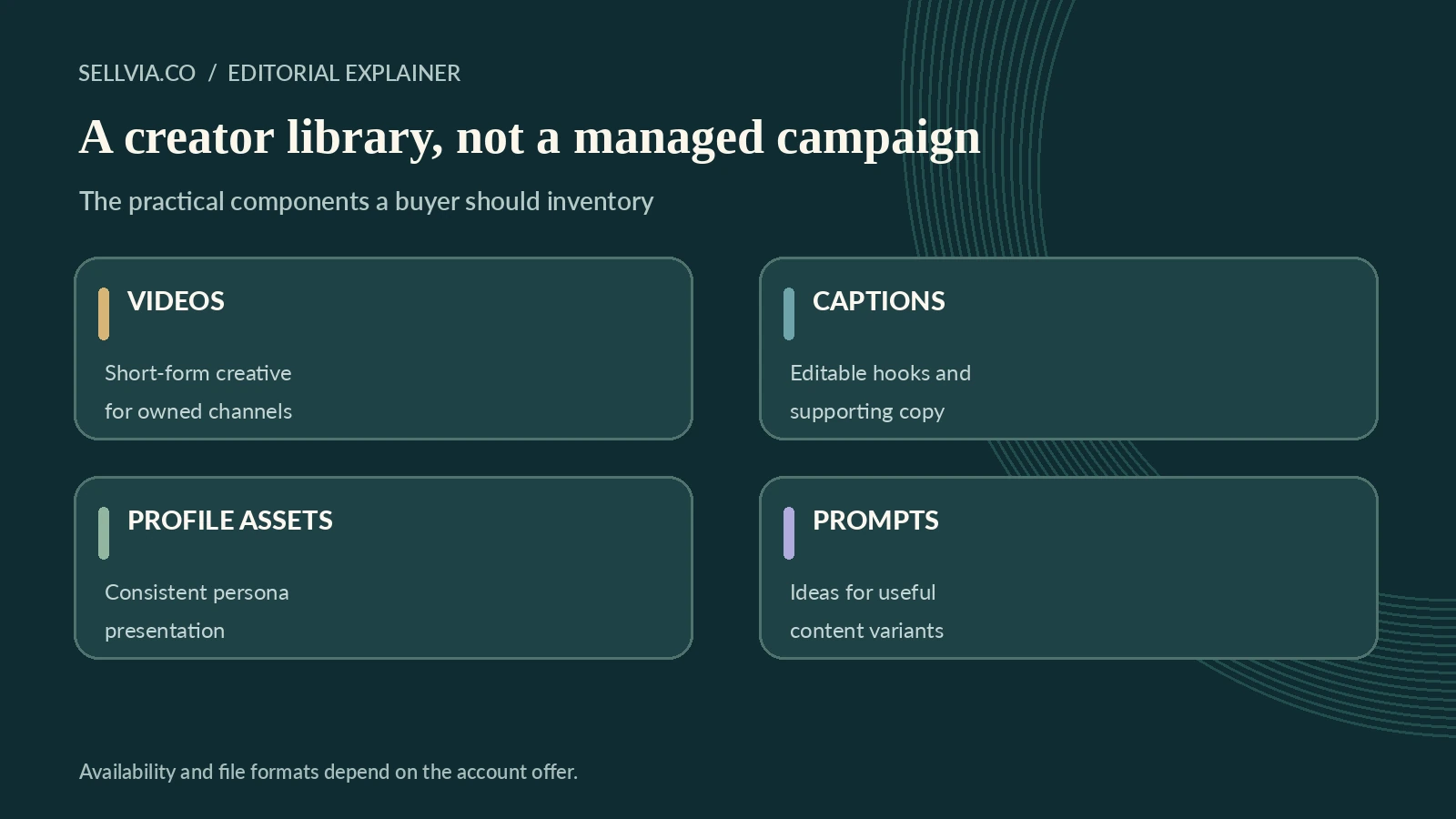
Current subscription terms describe a library of downloadable digital marketing materials. Depending on the account and plan, those may include ready-made videos, written captions, profile assets, prompts and related files. This is a practical cluster rather than an automatically managed social account. Each component addresses a different bottleneck: the video handles production, the caption helps publication, profile assets promote visual consistency, and prompts create a starting point for variations.
For a merchant operating alone, the main saving can be the setup time avoided. Producing one polished vertical clip normally requires an idea, a script, a person or character, framing, editing, a caption and final checks. A packaged asset removes some of those steps. It does not remove the need to identify the right audience, confirm the relevance of the message, or decide whether a post belongs on Instagram Reels, TikTok or YouTube Shorts.
A sensible delivery check begins with the folder structure. Are the files named clearly? Do videos play without conversion? Are the captions separate and editable? Can the owner identify which assets belong together? These modest questions have an outsized effect on whether an exciting product becomes an actual content routine.
The strongest use case is consistent presentation
A recurring virtual character is easier to recognize than a random collection of stock scenes. The viewer may remember a face, wardrobe, pacing or familiar visual setting. For a small digital store without a recognizable human host, that repeated identity can make posts feel connected. This is the feature I find most useful in principle: a consistent presentation layer can be created without the owner booking a shoot every time there is a new topic to explain.
Consistency is only valuable when it carries substance. If seven clips repeat the same general promise about online business, the series is not an editorial asset; it is repetition in prettier packaging. I would map each clip to a concrete customer question. One might address choosing a study template, another might discuss organizing an online course, and another might explain how to compare two types of digital guide. A focused sequence gives a familiar face a reason to appear.
There is also a brand-fit check. The same virtual presenter may be suitable for a casual educational brand but too energetic for a conservative B2B publication. Before building a whole calendar, compare the persona's tone with the language already used on the store's main pages. If the character communicates an entirely different personality, the visual consistency becomes a problem rather than a benefit.
The trial should be treated as a creative inspection window
The subscription terms describe trial access to a small starter selection, with the exact duration and subsequent billing governed by the offer displayed at checkout. That is enough to create a useful trial plan. Instead of rushing to publish every supplied file, inspect a small set for voice consistency, relevance, subtitles, branding and export quality. Then attempt to prepare a complete post, from downloaded video to final caption and destination link.
My preferred trial test has three parts. First, play each clip from start to finish, once with sound and once muted. Second, open it inside the posting preview for the target platform and examine the framing. Third, read the supplied caption as an ordinary follower would. Does it say something specific, or does it sound like interchangeable promotion? Those checks produce more useful information than simply confirming that a download button works.
Another practical detail is the renewal rule. A trial for the AI Influencer service must not be confused with the base store trial. Different subscriptions can have separate billing cycles, prices and cancelation controls. The current checkout should be treated as the definitive offer for that account, especially because older subscribers can retain different terms. A careful buyer can enjoy the convenience while keeping an accurate list of active services.
Video files are only half of the package
An editor can rescue a good visual with a strong caption, but cannot rescue a message that is misleading or irrelevant. That is why the accompanying text deserves its own review. I would look for captions that identify a useful problem, deliver one clear idea and end with a reasonable next step. A short educational hook often serves a digital-product store better than a sweeping income promise.
Consider a template store. A video may show a virtual host introducing the idea of planning a weekly project. The caption should connect that topic to the actual template available in the store, explain what the template contains and use a restrained invitation. It should not claim that a fictional host personally used the product for years. The best pairing feels like an informative introduction to a resource, not a synthetic endorsement.
Captions are also where minor localization issues become visible. A phrase that looks natural in a headline may feel overly promotional in a short video. The owner should be able to edit spelling, tone, hashtags and calls to action without rebuilding the video. If the supplied material is easy to revise, the package becomes a flexible base rather than a fixed script.
Separate the persona from real human proof
An AI character is a creative tool. It is not a customer review, an employee biography or a real influencer relationship. That is not a disadvantage when the content is presented clearly. In fact, the honesty of the format can become a strength. Animated and synthetic characters have long been used to explain products and ideas; modern generative tools simply broaden the range of visual styles available.
The editorial line I would draw is simple. A virtual presenter may explain a guide, narrate a checklist or dramatize a general question. It should not claim a private purchase, a measured result or an authentic life event unless those claims are clearly fictionalized and cannot mislead a viewer. This protects the merchant's credibility and prevents an attractive visual from creating legal or reputational problems.
Platforms also have rules for synthetic and promotional content. The account owner—not the content library—decides where and how to disclose an ad, a synthetic presenter or a paid relationship. A successful workflow keeps that final review attached to every export, just as it would with human-shot video.
Who should handle posting and scheduling?
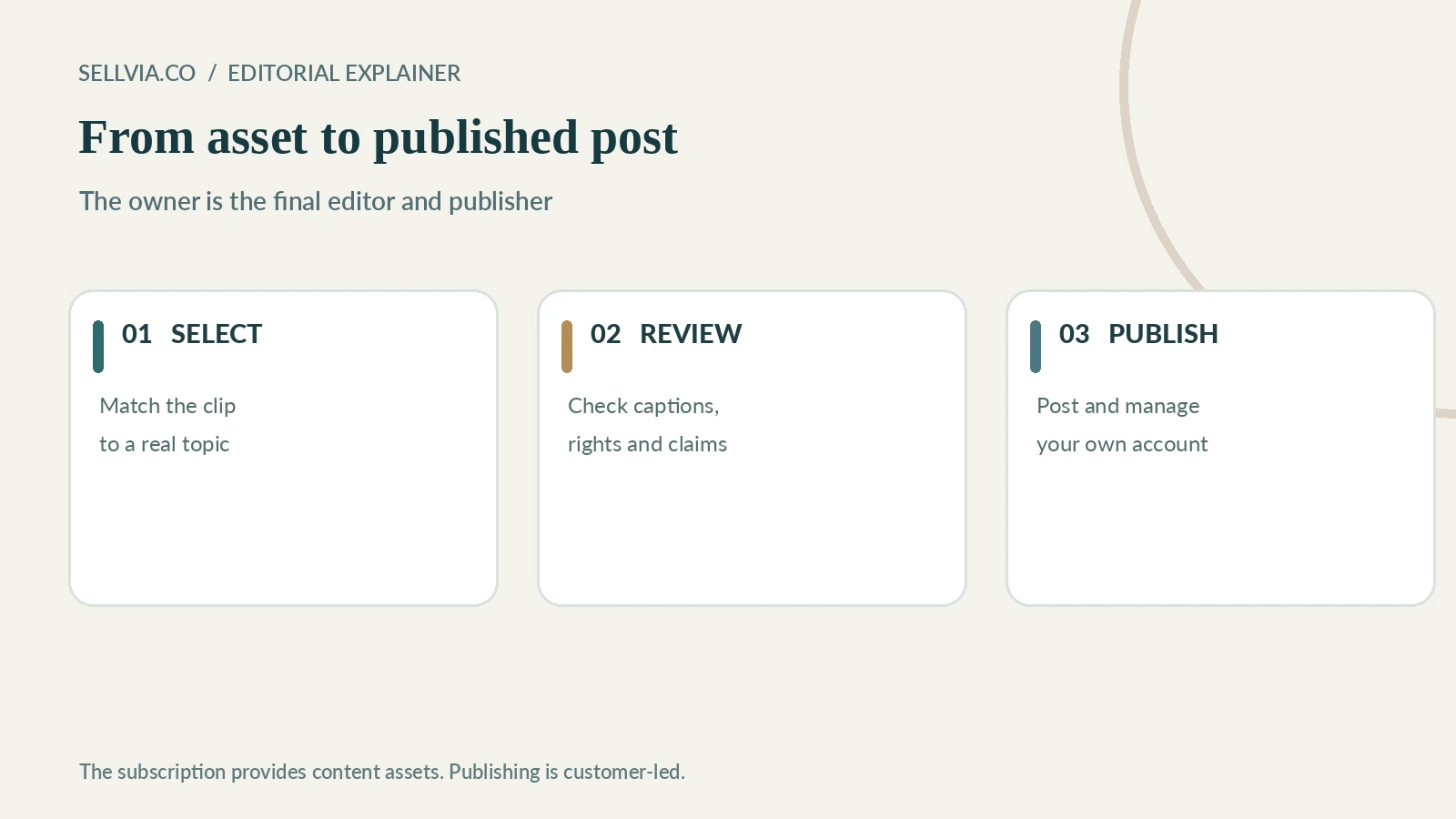
The subscription gives the customer assets, not a managed publishing team. Downloading, checking, scheduling, posting, moderating and analyzing results remain separate jobs. It is important to say this plainly because the phrase AI influencer can imply an automated personality operating an account around the clock. That is not what the standard subscription describes.
I regard this division as reasonable for an entry-level content product. Some business owners want a queue of assets but prefer to keep their own accounts and messages under direct control. Others want a managed service and should shop for one explicitly. The marketing value changes considerably between those arrangements, so the product is easier to like when its scope is precise.
A simple publishing routine might involve one hour each week: choose relevant videos, personalize captions, check link destinations and schedule the posts using the merchant's preferred platform. The exact time saving depends on how much editing is required. A package that looks finished but needs extensive fixes may save less labor than a smaller, more adaptable collection.
The digital-product fit matters more than the character's looks
Sellvia's current digital-catalog focus means the footage should support educational and downloadable offers, not unrelated physical-product demonstrations. This is a useful editorial test because visually impressive AI footage can still be wrong for the store. If a clip shows a scene with no connection to the actual course, guide or template being promoted, the owner has received decoration rather than useful sales communication.
Imagine three content themes: learning a skill, simplifying a workflow and using a ready-made resource. Those are natural subjects for a digital-product catalog. The character can introduce a question, demonstrate the broad idea and invite viewers to inspect a specific resource. Showing a meaningful customer benefit is more important than making the persona appear glamorous, expensive or famous.
The most effective content usually starts from the store's existing product descriptions. Pick a topic already explained on the site; identify the first question a visitor would ask; then select a clip that supports that answer. This reduces mismatches between a social post and the page to which it links.
How I would judge the first three videos
For each supplied clip, score five characteristics from one to five: visual clarity, natural motion, sound intelligibility, subject relevance and editability. A sixth criterion—honesty of claims—should not be averaged away. If a clip makes an unsupported personal claim, it needs revision regardless of how attractive the image looks.
I would also examine the opening two seconds, where the viewer decides whether to continue scrolling. Does the opening provide a reason to watch? Can the idea be understood without sound? Is the character framed safely away from interface elements? Those are concrete production questions, not subjective enthusiasm. They also tell the merchant which files deserve priority in a short trial.
A sample scorecard should be kept as a working document, not presented as a measured result unless the assets were actually opened. The value of this method is repeatability: a store owner can compare future batches against the same criteria instead of accepting every new file simply because it belongs to a subscription.
A note on public influencer-video examples
Sellvia Mall has publicly listed digital influencer video packs with descriptions of vertical clips, captions and a recurring character. Those listings are useful illustrations of the broader format. They are *not* evidence that the Dashboard AI Influencer Subscription includes the same files, video counts or commercial rights. The two offers should be compared only after a specific account's deliverables are visible.
That distinction matters in a review because a promising example can create expectations beyond the product being purchased. I would use a public example to understand the visual category, then use the actual subscription trial to verify file inventory and permitted use. A buyer benefits from seeing the difference rather than having every AI video offer grouped together under one broad label.
The economics are really about production hours
There is no honest way to calculate a guaranteed return on an AI video subscription from the subscription fee alone. Social distribution varies too widely, and the service does not promise an audience. A more useful calculation compares production tasks. How long would it take to write, record and edit comparable content from scratch? How much time is needed to adapt and publish the downloaded version? The gap is the labor saving worth investigating.
A small business might find that access to a modest library reduces the work required to maintain a weekly content habit. That would be a valid operational benefit even before traffic or sales are measured. But the product should not be praised for results that the owner has not observed. The strongest positive argument is lower production friction and more predictable access to creative starting points.
If the owner already has a clear visual identity and a fluent on-camera presenter, the package may be less important. Optional services are most valuable when they remove a genuine constraint, not merely because they are available in the account.
What I would improve before publishing a clip
The first adjustment is relevance: replace a broad opening with a specific question connected to the store's digital catalog. The second is typography: if subtitles or callouts are too small for a phone, regenerate or simplify them. The third is pacing: trim an unnecessary introductory pause before the useful idea starts. None of these changes should require turning a short promotional post into a full-scale production.
Next, check the persona's appearance and voice across multiple clips. Small differences are normal in creative media, but obvious identity shifts can confuse followers. Finally, inspect the closing call to action. A video that ends with a useful invitation to learn more is usually stronger than one that presses viewers toward an unrelated promise of easy money.
These edits are also an opportunity to make a video genuinely your own while staying within the license. The best use of a content library is not blind duplication. It is a consistent base that can be matched to a product, audience and publishing calendar.
Editorial verdict: a useful creative shortcut, with clear boundaries
My assessment of the AI Influencer Subscription is favorable for the right type of user. The appeal is tangible: recurring digital-character content, associated text and a lighter production workload. That is attractive for a merchant selling courses, guides or templates who wants a recognizable voice without appearing on camera. The strongest advantage is the ability to begin with something more developed than a blank editing timeline.
I would not call it a managed influencer campaign, an audience-growth guarantee or proof that every clip is publication-ready. The practical verdict depends on the actual sample files, how easily the merchant can adjust them and whether the content stays accurate. A well-defined creator library is a helpful tool; a clear-eyed buyer will know exactly which parts of the work still belong to them.
Frequently asked questions
Is the AI influencer a real person?
No. The standard service uses a virtual AI-generated character. A store should not present that character as a real customer or an independent reviewer with personal experience. Its useful role is to deliver explanatory or promotional content with visual consistency.
Does the subscription publish videos for me?
Not as a standard feature. The merchant is responsible for reviewing, editing, uploading, scheduling and monitoring content on their own accounts. Any managed publishing arrangement should be confirmed separately in writing.
Are captions part of the offer?
The publicly described package may include captions and other supporting assets. Confirm the precise file inventory and editing rights in the applicable Dashboard and checkout offer before depending on those items for a publishing schedule.
Can I use videos for digital courses and templates?
That is a sensible content use case when the material matches the product and the relevant license allows it. The safest posts explain actual features of the resource without inventing personal testimonials, results or guarantees.
Will the trial automatically cover other paid services?
No. Subscription terms and trials are service-specific. The AI Influencer Subscription can have a different renewal cycle from the base store and other add-ons. Read the exact checkout amount and next charge date for the account.
What should I check first after download?
Open the actual file, watch it with and without sound, inspect mobile framing and check captions against the product page. Then assess how much editing is required before you can responsibly publish it.
Does an AI persona come with followers?
No. A virtual presenter is a creative asset, not an established human creator with a transferable audience. Distribution and community-building remain the account owner's work.
Is every public influencer pack the same subscription?
No. Individual digital packs advertised elsewhere in the Sellvia ecosystem can differ substantially from the Dashboard subscription in access, quantity, pricing and licensing. Compare the actual product being purchased.
Sources and related reading
• Sellvia Terms of Use — AI Influencer Subscription
• Sellvia Mall — example of a separately sold digital AI video pack

Andrew Porter is an ecommerce writer and online business researcher at Sellvia.co. He focuses on Sellvia’s platform features, pricing, digital product tools, built-in advertising, order management, and payment processes. Andrew creates clear, research-based content that helps beginners understand how the platform works, assess the required budget, explore its advantages and limitations, and make more informed decisions about launching an online business.
Leave a Reply