Editorial verdict. Sellvia provides several visible ways for store owners to seek help, including a public Help Center, a contact form, a published support email and in-account guidance documented for some dashboard versions. The strongest part of this arrangement is the combination of self-service instructions with a route to ask a person when something cannot be resolved through an article. For a new digital-store owner, knowing where to ask and what evidence to provide is a practical advantage. However, a complete assessment of customer support must distinguish a discoverable channel from a proven fast or successful response.
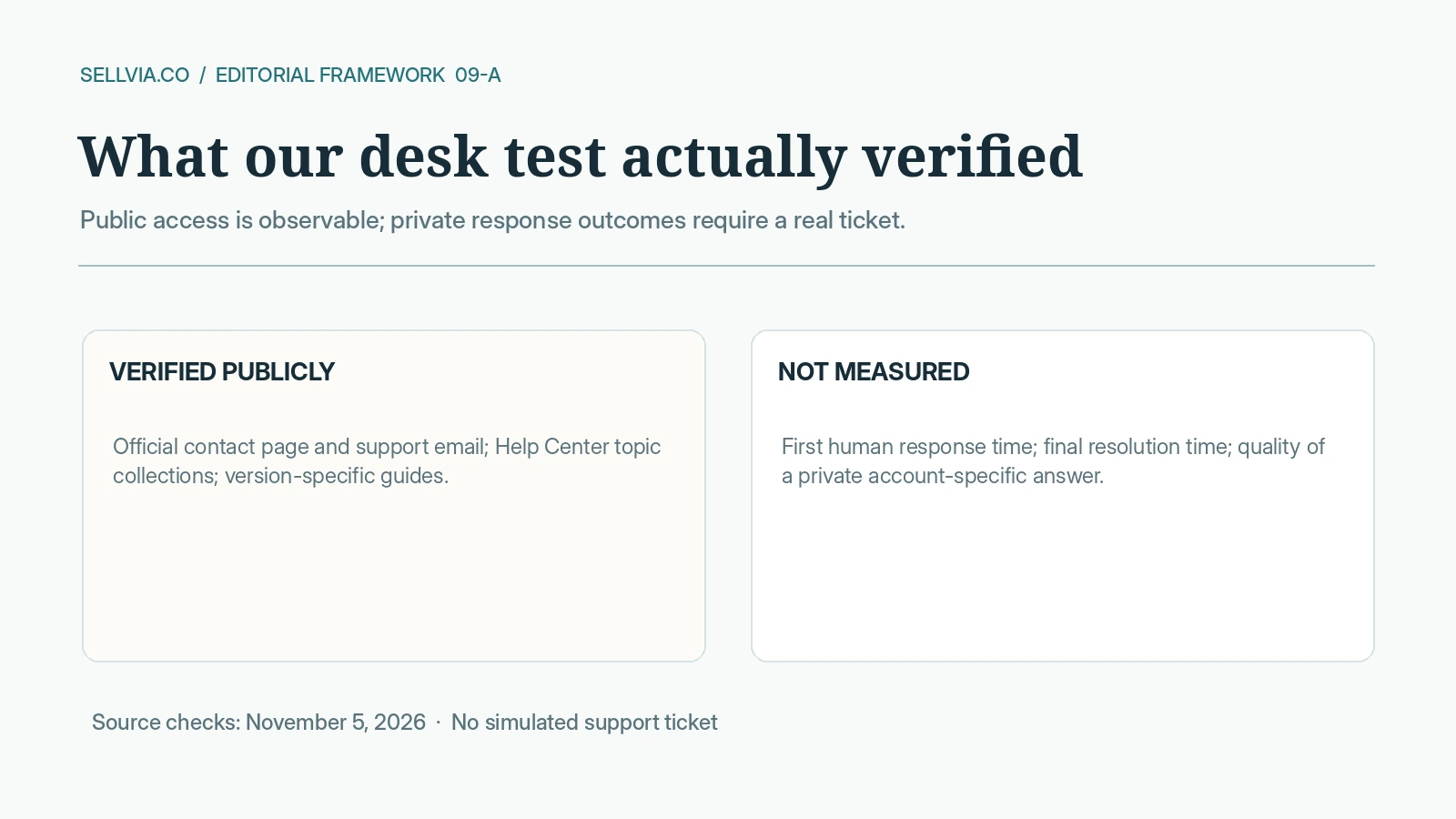
This is an independent editorial desk test of public support accessibility and documentation. On November 5, 2026, we inspected Sellvia’s official contact page, Help Center categories, selected support-related navigation and independent review summaries. We did not submit an account-specific ticket, start a private chat, receive a reply or measure a live case to resolution. Consequently, there is no invented “13-minute response” or “problem solved in 45 minutes” anywhere in this review. The response-time portion of a live support audit remains unmeasured until an actual, documented interaction is available.
The question worth testing is larger than speed
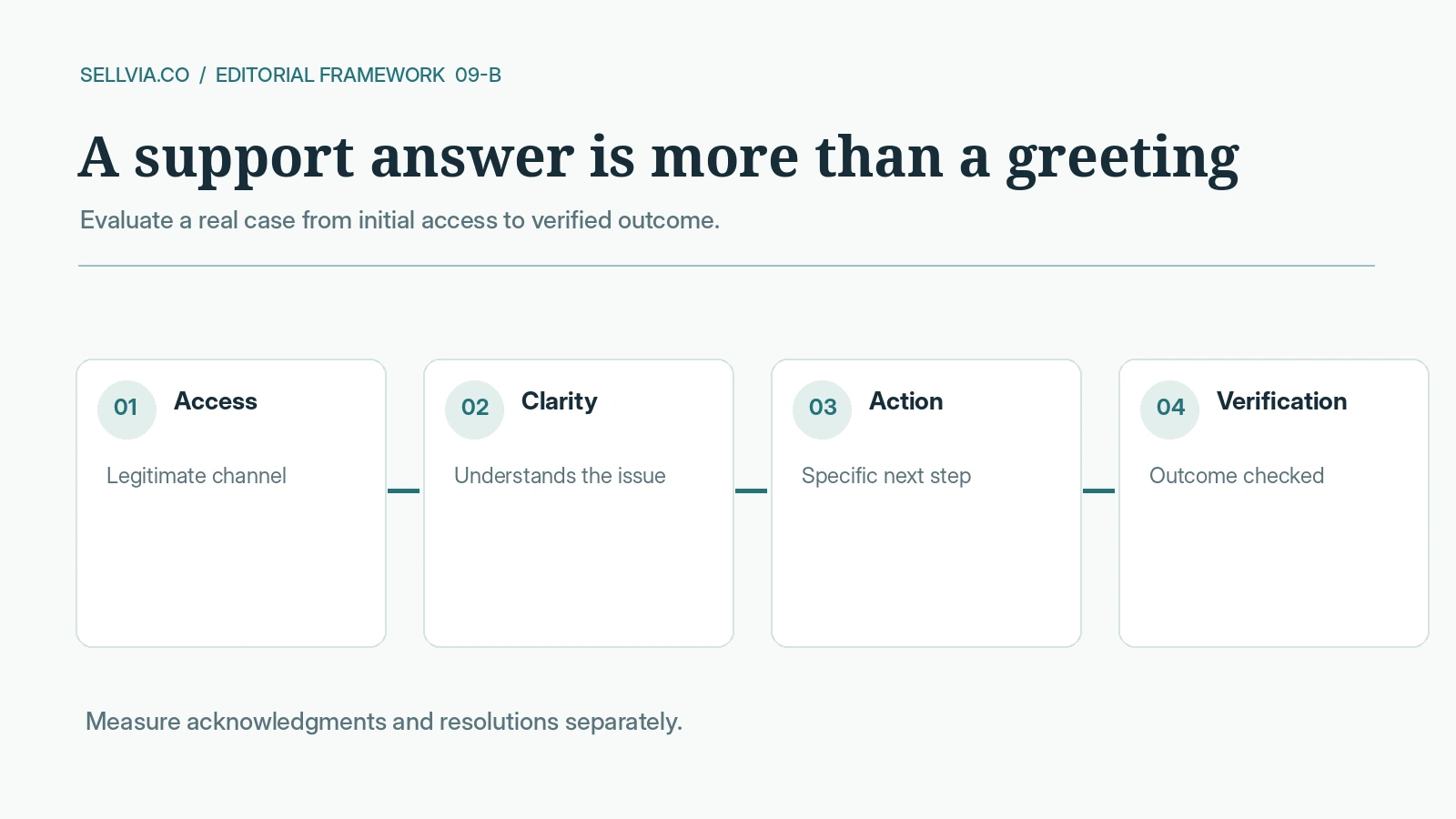
A support team can answer immediately without solving the problem. Another may take longer but provide the exact steps necessary to repair it. For an operational service, four dimensions matter: access, understanding, resolution and follow-through. Access means a user can locate a legitimate channel. Understanding means the response identifies the actual problem instead of offering generic reassurance. Resolution means the instructions work. Follow-through means the promised next action is recorded and confirmed.
That is why this review does not simply repeat a marketing claim about around-the-clock help. A meaningful evaluation must consider which channels are documented, what the help materials already explain and how a subscriber can assess a real interaction without relying on anecdotes. Sellvia’s published resources offer a substantial starting point for that exercise.
What we could verify without an account
The official Contact Us page presents a message form with required email information and publishes [email protected] as the support-team address. The public Sellvia Help Center contains named collections covering getting started, dashboard functions and other product topics. Both were accessible as public information during our desk review.
We also opened the Getting Started collection, which displayed 27 articles, and the Sellvia Dashboard collection, which displayed 42. These counts are a snapshot of the public navigation, not a guarantee that every article is applicable to every dashboard version. Their practical significance is that subscription, account and daily-operation questions can be looked up before contacting a person.
The homepage advertises dedicated-manager guidance and technical help. Those are provider statements; they do not establish the waiting time or outcome of a specific private support interaction. Public contact information, by contrast, is directly verifiable without creating an account. This difference between evidence types informs our evaluation.
Test 1: Can a customer find a legitimate support channel?
This first public test has a straightforward outcome: yes, the official website exposes a contact form and support email. A visitor does not need to rely on a third-party message, an unofficial social profile or a search-engine snippet to discover a way to ask a question. That is a concrete positive for a service involving subscriptions, digital products and access to a business dashboard.
A user should still verify that the link is on the intended official domain before submitting anything sensitive. An email address appearing in an unrelated forum thread is not equivalent to the address published on Sellvia’s own contact page. Save the page URL and the time of the request; it provides a reliable starting record if a conversation later needs follow-up.
An account may offer additional chat or manager channels. We have not logged into a current subscriber dashboard to confirm their exact availability or hours, so we do not present every channel shown in marketing materials as universally enabled for all users.
Test 2: Are basic answers organized for self-service?
The Help Center’s organization is encouraging. Its Getting Started collection contains topics about subscription management, payment methods, order processing, account operation and introductory store questions. The Dashboard collection includes guides on products, orders, balance and payouts, fees, account areas and support navigation. It also distinguishes some documentation for a newer dashboard variant, which is particularly relevant when interfaces differ between accounts.
This is useful because a subscriber should not have to wait for a human answer to every ordinary “Where is this control?” question. Well-organized articles can reduce repeated requests and allow an owner to learn at their own pace. The existence of those categories is a positive finding from the desk review; whether an individual article solves a private issue must still be tested against that person’s interface.
We consider the separation between introductory guides and more specific dashboard documentation important. Readers can begin with the general feature, then navigate toward the exact setting or transaction. A single catch-all FAQ would be less helpful for questions involving different account versions.
Test 3: Does the documentation acknowledge account variations?
Sellvia’s Terms of Use note that dashboard versions, available tools and subscription benefits may differ by account type or signup flow. The Help Center likewise contains guides labelled for different dashboard versions. That alignment matters: instructions for one interface need not be accurate for another, and an owner should not assume that missing buttons prove a failure.
A good support response should begin by identifying the user’s actual account version and the name of the feature involved. If a representative provides steps that do not match the screen, the helpful follow-up is to request instructions for the displayed version, preferably with the current section name. That is far more productive than repeating the same steps on the wrong interface.
For the editorial test, the existence of version-specific documentation is a favorable sign of organization. It does not establish that every article is current or that all subscribers can move between versions. The contractual terms explicitly limit those assumptions.
Test 4: What does a strong answer look like?
Consider a realistic question: “My storefront has a branded email address, but I cannot find where mailbox access is configured.” A weak response merely restates that branded email is included. A useful response should identify the account version, show the relevant settings or confirm that the team must provision access, explain what the subscriber should expect next, and provide a route to confirm sending and receiving messages.
The quality difference is in specificity. The answer should identify a location, action, expected result and escalation path. Ideally it also warns the user not to share login credentials in an unsecured message. If a screenshot is needed, it should show the non-sensitive part of the interface. These are evaluation criteria, not claims about a response that Sellvia sent us.
Support often creates value by explaining responsibilities clearly. A platform can include hosting but limit server-level controls; some tasks require assistance. The published Terms describe exactly that kind of arrangement for the turnkey hosting service. A helpful support agent should therefore tell the user which tasks are self-service and which ones are handled by the support team.
Test 5: Can the customer explain the problem well enough to solve it?
A fair support test begins with a well-formed request. The owner should state the issue, which page or dashboard version is affected, what they expected, what happened instead and the steps already attempted. Screenshots can help, but should omit private customer details, full payment information and security codes. An exact error message is usually more useful than a broad statement such as “nothing works.”
For example: “In my assigned dashboard, I opened the Products section and tried to update the first paragraph of a digital guide’s description. The Save control returned [exact message]. I tried again after refreshing once. What should I check?” The bracketed error is illustrative, not a reported Sellvia error. It signals that the user should copy the actual message, not invent one.
This preparation does not excuse poor service; it improves the possibility of a productive interaction. It also enables objective evaluation. If the agent addresses the described issue and the action works, the case can be marked resolved. If the answer talks about unrelated tools, the mismatch can be documented.
Channel selection: choose by the question, not by habit
| Situation | Strong starting point | Evidence worth keeping |
|---|---|---|
| Learning a standard feature | Help Center | Article URL and section |
| Unclear pricing or account status | Account details, then official support | Service name and dated account screen |
| A reproducible technical fault | Official support email or available in-account channel | Steps, error and sanitized screenshot |
| Product positioning or next priorities | Available Growth Manager | Written next-step summary |
| A missing feature in a different dashboard | Version-specific Help Center article | Version and exact menu labels |
| A request requiring account verification | Official support channel | Ticket reference and written outcome |
The table is an editorial routing framework. It does not claim every account provides every contact method. The central idea is simple: choose the route that is best equipped to provide the requested outcome, then preserve enough evidence to verify the response.
A real response-time test would need a repeatable protocol
One message on one day is insufficient to establish typical support speed. A credible live test should use a clearly legitimate account, a real operational question, a timestamped request and a written record of subsequent responses. The analyst should distinguish the first acknowledgment from the first useful answer and the final resolution. If the issue requires escalation, the clock should not stop at “we forwarded this.”
A stronger design would compare several ordinary questions at different times, while respecting the provider’s terms and avoiding repetitive artificial load. A trial inquiry about account navigation and a complex billing investigation cannot be evaluated against the same expectation. Nor should a support team be penalized for requesting necessary verification before making account changes.
For this article, these live metrics are explicitly not available. We therefore report no measured average, median or guaranteed service level. Any future measurement would need its date, timezone, question category, channel and actual response transcript or ticket history. Readers should be cautious of reviews that assign exact response times without showing how the times were obtained.
The follow-through standard that separates help from reassurance
Many support interactions involve more than one message. The first response may identify a next action, request account confirmation or hand the issue to another team. A useful service should make the next step understandable: who owns it, what information is required and how the customer will know it is complete. This is especially important when a configuration change affects public store access.
For an owner, the practical record can be short: original request, first substantive answer, requested action, verification test and final state. If a support representative promises a change, the owner should confirm it in the relevant account or public page rather than assuming the change succeeded because the conversation sounded reassuring.
This approach supports a fair evaluation. Some problems are resolved by the customer’s next step; others need technical intervention. Either can be handled well when the support process is specific and traceable. Friendly language is welcome, but it should accompany meaningful progress rather than substitute for it.
What independent reviews suggest, and what they do not prove
At the time of our review, Capterra’s Sellvia reviews page displayed a 4.6/5 customer-service rating in a 49-review sample. This is a favorable signal of reviewer sentiment and provides context beyond the company’s own claims. It is not a controlled test of support availability, a service-level guarantee or proof that every user gets the same experience.
Different reviews describe different versions and historical operating models. Some remarks may concern legacy platform features or accounts outside the current digital-product store offer. For that reason, we do not import unrelated observations about older operating arrangements into this specific review. A useful editorial analysis takes review context seriously rather than stitching together positive excerpts without checking relevance.
The right conclusion is modest but meaningful: Sellvia has public support routes, substantial help-center navigation and a positively rated customer-service experience among a group of independently hosted reviewers. The missing piece, which we do not invent, is a documented, current live-ticket outcome from an account assigned to the relevant digital-product model.
Why the help center is valuable even when human help exists
A searchable explanation allows an owner to solve routine questions at the moment they arise and to revisit instructions without starting a new conversation. That can be especially useful for those learning a new interface and for users who prefer reading a clear sequence before making a change. The Help Center’s dedicated dashboard section is a stronger starting point than general search snippets, which may describe an outdated version.
Its value also lies in giving a support exchange shared terminology. Instead of asking “where is my money?” a user can identify the particular balance or payout field and then ask a more precise question. The support team can respond more specifically, and the customer can verify the answer against the actual screen.
We would still encourage every owner to treat a help article as a guide rather than a contract. Where a question involves exact subscription entitlements, payment rules or cancellation effects, check the applicable Terms and account records as well.
An illustrative support case: clear expectations without invented results
Imagine a subscriber whose store domain has changed but whose public contact address still uses the old name. A responsible support request would identify the original and new domains, describe which email setting appears inconsistent and ask whether mailbox configuration requires action by Sellvia or the owner. The subscriber should provide non-sensitive screenshots and request written confirmation of the completed steps.
A strong reply would describe what can be changed, any limits of the subscribed service, who performs the change, and how the customer can verify the resulting sender identity. A weak reply would merely tell the subscriber the domain looks correct without addressing the mailbox. This contrast illustrates the clarity and follow-through standard, but no such exchange was conducted for this review.
This example is particularly relevant because a branded email address is included in the documented turnkey package, yet the existence of an address does not by itself verify outbound deliverability. A support team earns its value by helping the owner move from a feature label to a working outcome.
Our editorial rating method: outcomes before adjectives
We would evaluate an actual case across five areas: channel discoverability, comprehension of the issue, actionability of the response, completeness of follow-up and transparency about next steps. Rather than inventing a five-star overall score, we separate what the desk review establishes from what remains open.
For channel discoverability, there is direct evidence: the public contact page and support address are visible. For structured self-help, there is direct evidence: the current Help Center offers labeled collections and version-related topics. For a private live response time, no first-hand evidence has been collected. For resolution quality and follow-through in a specific case, no actual support transcript was provided. Recording these limits makes the positive findings more credible, not less.
Positive editorial assessment, with a clear boundary
Sellvia’s support structure is encouraging for someone who is not a technical specialist. The public site exposes an official contact channel, and the Help Center is organized around real user tasks such as getting started, understanding dashboard sections and handling account questions. This reduces the risk that a new user must discover every basic answer through trial and error.
The independent customer-service score on Capterra adds favorable context. Still, we will not describe the support as “tested fast” or “personally resolved” without a real timestamped case. Our conclusion is positive about accessibility and documented guidance, while actual response speed and case resolution remain unverified in this desk review. That is the line between a professional editorial evaluation and invented firsthand experience.
Frequently asked questions
How can I contact Sellvia support?
The official website provides a contact form and lists [email protected]. Some accounts may also have in-dashboard assistance or manager contact options; check what is available in your assigned dashboard.
Is the Help Center public?
Yes. The Sellvia Help Center has public collections covering onboarding, subscription management and dashboard features. It can help clarify a question before contacting support.
Did this review send a test ticket?
No. It is an editorial desk test of published contact routes, help content and external feedback. No private support exchange, response time or solved ticket is claimed.
How fast does Sellvia respond?
We cannot provide a verified current response-time figure without dated ticket evidence for the relevant service and channel. Published general marketing statements should not be treated as measured averages for every account.
What should I include in a technical support request?
State the issue, account or dashboard version, expected outcome, actual result and steps attempted. Attach a sanitized screenshot if helpful; never disclose a password or full card number in a message.
Is a Growth Manager the same as the support team?
A Growth Manager may help with priorities and onboarding. An issue involving technical configuration, account verification or billing should normally follow the channel authorized for that task. If unsure, ask to be directed to the responsible team.
What matters more: a fast greeting or a useful answer?
A useful answer. Record first acknowledgment separately from the first substantive response and final resolution. This prevents a polite automatic message from being mistaken for a solved problem.
Sources and method. Sellvia contact page; Sellvia Help Center; Getting Started collection; Dashboard collection; Sellvia Terms of Use; Capterra review summary. Public-source audit November 5, 2026. No direct support response, live ticket or exact resolution-time measurement was available.

Veronica Jameson is a digital commerce analyst and contributing author at Sellvia.co. Her work explores the practical side of launching and operating an online business, with particular attention to platform usability, advertising decisions, startup budgeting, and performance analysis. Veronica approaches each topic from a beginner’s perspective, breaking down unfamiliar processes and highlighting the details that can influence day-to-day results. Her goal is to give readers realistic context and useful guidance rather than simplified promises.
Leave a Reply